
Swisher Urges Valve to Rethink CS2 Major Sticker System After M80 Secures Singapore Spot


Michael “Swisher” Schmid has called attention to one of the biggest economic questions surrounding the next Counter-Strike 2 Major, saying that teams are hoping Valve will reconsider its approach to Major stickers.
The M80 player made the comments after his team strengthened its position for the PGL Singapore Major 2026 with a victory over Legacy at ESL Pro League Season 24. While qualification represents a major competitive achievement for M80, Swisher suggested that the financial value traditionally attached to reaching a Major has become less certain following the sticker-system overhaul introduced for IEM Cologne Major 2026.
Quick Summary
| Key point | Details |
|---|---|
| Player | Michael “Swisher” Schmid |
| Team | M80 |
| Main issue | Valve's revised Major sticker economy |
| Context | M80 secured its Singapore Major position after beating Legacy |
| Swisher's concern | Reduced financial benefits, particularly for tier-two and tier-three organizations |
| Previous Major | IEM Cologne Major 2026 |
| Next Major | PGL Singapore Major 2026 |
| Valve change confirmed? | Yes — the sticker purchasing and revenue-distribution model changed for Cologne |
| Further changes for Singapore? | TBD |
| Valve response to Swisher | TBD / none confirmed |
What Did Swisher Say About Valve and Major Stickers?

M80's Michael “Swisher” Schmid says teams are hoping Valve will reconsider its approach to Major stickers.
Speaking to HLTV following M80's ESL Pro League Season 24 run, Swisher said there is widespread hope within the scene that Valve will reconsider its current sticker system.
“I think everyone is hoping that they rethink their stance on the stickers and the system.”
He added that the difference created by the new model had been particularly difficult for organizations outside the top level, saying that “everybody suffered, especially tier-two, tier-three orgs.”
That distinction matters. Swisher was not announcing a Valve policy change or claiming that one is imminent. His comments represent a player's assessment of the system and his hope that Valve responds to industry feedback.
As of October 7, there is no confirmed announcement cited here showing that Valve will abandon or substantially redesign the system for Singapore.
Why Swisher's Comments Matter
The issue reaches well beyond cosmetic items.
Major sticker revenue has historically made qualification financially important to organizations and players. For smaller organizations in particular, that income can potentially influence budgets, roster sustainability and the economics of maintaining a competitive CS2 team.
The Cologne overhaul changed that equation.
Valve replaced the familiar sticker-capsule acquisition model with a token-based Major Shop in which fans could directly select individual stickers. Prices were tied to relative demand.
Valve also formalized how Major-related royalties were distributed.
According to the Cologne system, 50% of Major Shop and Major Pass revenue was allocated as royalties to the tournament organizer, teams and players. The tournament organizer received 5%, while the remaining share was distributed across teams according to VRS position before the final and Major placement afterward. Half of each team's allocated royalty went to the organization and half was divided between its five players.
That made both the purchasing mechanism and the distribution model substantially different from previous Majors.
Background: What Valve Changed at IEM Cologne Major 2026
The Cologne Major marked a fundamental experiment with Counter-Strike's tournament-item economy.
Instead of buying randomized sticker capsules, fans could use tokens to acquire the specific sticker they wanted. Demand then influenced the token price of individual items. Valve also introduced a mechanism to compensate buyers when a sticker's price dropped significantly shortly after purchase.
The initial implementation drew criticism.
HLTV subsequently reported concerns from participating organizations about sharply reduced sticker revenue. One Stage 1 organization told the publication that its organizational share was approximately $60,000, with a corresponding amount going to players under the new split. Because several organizations were reportedly restricted from disclosing exact figures, comprehensive team-by-team revenue data is not public.
Valve did later react to one obvious problem.
In July, the developer released another Cologne sticker series and acknowledged that the original implementation had not generated reasonable prices. HLTV reported that the revised series dramatically lowered the upper end of sticker pricing compared with the initial release.
That historical detail makes Swisher's comments particularly relevant: Valve has already adjusted part of the system, but there is no confirmation that the broader revenue structure will be redesigned for Singapore.
From Cologne to Singapore: Sticker-System Timeline
| Date | Development | Significance |
|---|---|---|
| May 2026 | Valve launches Cologne Major tournament items | New token-based direct-purchase model replaces traditional sticker capsules. |
| May 2026 | New royalty structure is detailed | 50% of Major Shop/Pass revenue goes to organizer, teams and players under the published distribution model. |
| June 2026 | Organizations raise concerns | HLTV reports major concerns over reduced sticker income. |
| July 29, 2026 | Valve releases revised Cologne stickers | Valve acknowledges the original system failed to produce reasonable prices and lowers pricing substantially. |
| October 6, 2026 | Swisher discusses the system | M80 player says teams hope Valve considers feedback and adjusts the model. |
| November–December 2026 | PGL Singapore Major | The next Major will provide the next major test of Valve's tournament-item strategy. |
A breakdown of Valve's IEM Cologne Major 2026 update, including the new sticker store, token economy and demand-based pricing.
M80's Major Qualification Changes the Context
Swisher's comments came at an important moment for M80.
The North American team defeated Legacy during ESL Pro League Season 24 after previously bouncing back from its defeat to BETBOOM with a victory against TYLOO. HLTV reported that the Legacy result effectively secured M80's Singapore Major position.
Swisher explained that locking in the Major early reduces pressure on the team and gives M80 more breathing room ahead of its planned bootcamp.
The competitive reward is therefore clear: M80 gets a place on Counter-Strike's biggest stage.
The financial reward is harder to predict.
That tension is at the center of Swisher's argument.
Key Details
| Category | Status |
|---|---|
| M80 Singapore Major qualification | Secured according to HLTV's report |
| Triggering result | Victory over Legacy |
| Competition | ESL Pro League Season 24 |
| Swisher's team | M80 |
| Cologne sticker model | Direct purchases using tokens with demand-based pricing |
| Revenue pool | 50% of Major Shop and Pass revenue distributed as royalties |
| Organizer allocation under Cologne model | 5% |
| Organization/player split | Half of each team's allocation to organization; half divided among five players |
| Singapore sticker format | TBD unless Valve confirms otherwise |
| Singapore sticker revenue | TBD |
| Confirmed Valve reversal | No |
Economic Impact on Tier-Two and Tier-Three CS2
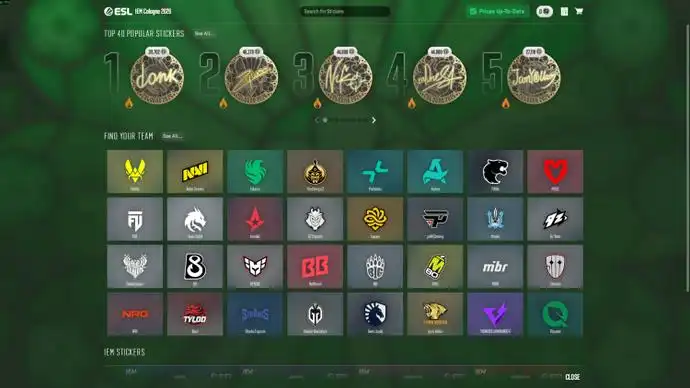
Major sticker revenue has become a key economic issue for teams and players following Valve's overhaul of the system for Cologne 2026.
Swisher specifically highlighting tier-two and tier-three organizations is significant.
The effect of Major qualification is not identical for every organization. Large organizations may have broader sponsorship, merchandise and commercial revenue streams. Smaller organizations can potentially be more exposed to fluctuations in tournament-related income.
HLTV's investigation into the Cologne system described the changes as contributing to more cautious spending among organizations and reported substantial declines in Major-item earnings in some cases. However, because complete financial records for every participating organization are unavailable, it would be misleading to assign a universal percentage decline to the entire field.
The safest conclusion is narrower: multiple organizations reported significant reductions, and Swisher says the effects were particularly painful below the elite level.
Historical Comparison: Old Capsules vs. Cologne's Model
| Previous approach | Cologne 2026 approach |
|---|---|
| Sticker capsules | Direct sticker selection |
| Randomized capsule contents | Fans choose the desired sticker |
| Fixed capsule purchase model | Token economy |
| Rare sticker acquisition partly driven by chance | Individual sticker prices influenced by demand |
| Revenue arrangements less standardized publicly | Valve published a defined royalty distribution |
| Established consumer behavior | New pricing system required adjustment |
From a consumer perspective, direct selection removes the uncertainty of opening a capsule.
Economically, however, removing that randomized purchase loop also changes how fans interact with tournament items. HLTV's reporting indicates that the initial Cologne implementation resulted in lower sales for at least some organizations.
It remains unclear whether subsequent adjustments were enough to solve that problem.
Tournament Impact: Why Singapore Matters
The PGL Singapore Major is scheduled for late November through December 13 and will feature 32 teams competing for a $1.25 million prize pool. It will also be the first Counter-Strike Major held in Southeast Asia.
For M80, qualifying therefore has two different dimensions.
Competitively, it gives the organization another opportunity to establish itself internationally.
Commercially, the eventual value of qualification may depend partly on what Valve does with Singapore tournament items.
If Valve retains the Cologne framework, organizations will have a clearer idea of how the revenue formula works but will still need to see whether demand improves.
If Valve modifies it again, Singapore could effectively become the second iteration of the company's redesigned Major economy.
For now, that remains speculation rather than a confirmed plan.
What Has Changed Now?
The immediate change is on M80's side rather than Valve's.
M80 can approach the remainder of the pre-Major period with far less qualification pressure. Swisher said recent LAN victories helped the team build enough VRS security to avoid having to chase every available result before the Major.
Valve's broader sticker policy, meanwhile, remains the unresolved variable.
The developer demonstrated after Cologne that it was willing to modify pricing and release another sticker series when the initial implementation produced undesirable results.
That does not, however, establish that another overhaul is coming.
What to Watch Next
The most important development will be Valve's official presentation of the Singapore Major tournament items.
Several questions remain unanswered: whether direct purchases remain unchanged, whether the royalty distribution is modified, how stickers are priced, and whether Valve introduces measures intended to improve revenue for lower-ranked organizations.
For M80 specifically, attention now shifts toward preparing for Singapore while continuing its ESL Pro League Season 24 campaign. At the time of the source article, HLTV listed M80's next EPL match against Spirit.
That provides an immediate competitive test against elite opposition while the longer-term sticker question remains outside M80's control.
Why This Story Has Longer-Term Importance
Major stickers sit at the intersection of esports competition, fandom and team economics.
A qualification spot is not merely an opportunity to win a trophy. Tournament items have historically attached additional commercial value to reaching Counter-Strike's most prestigious events.
That means Valve's decisions can indirectly influence the financial incentives surrounding the entire competitive ecosystem.
Swisher's comments are especially notable because M80 have achieved exactly what teams spend months pursuing: a Major berth. Yet the conversation immediately turned to uncertainty over how valuable that accomplishment will be financially.
For organizations operating outside the richest tier of Counter-Strike, that uncertainty could influence future roster investment and tournament planning.
There is not yet enough public evidence to quantify that long-term impact across the ecosystem, so any stronger conclusion should wait for additional revenue data and Valve's Singapore policy.
FAQ
What did Swisher say about Valve's sticker system?
Swisher said that “everyone is hoping” Valve reconsiders its stance on Major stickers and takes feedback into account. He specifically argued that tier-two and tier-three organizations suffered under the Cologne system.
Why did Valve change CS2 Major stickers?
Valve introduced a new tournament-item model for IEM Cologne Major 2026 that allowed fans to directly obtain individual stickers with tokens rather than relying on traditional sticker capsules. Sticker prices were influenced by relative demand.
How was Cologne Major sticker revenue distributed?
Valve stated that 50% of Major Shop and Major Pass revenue was distributed as royalties. Five percent went to the tournament organizer, while the remaining team allocations depended on VRS position before the final and Major placement afterward. Each team's allocation was split equally between its organization and players as groups.
Has Valve confirmed changes for the Singapore Major?
No broader Singapore-specific reversal or redesign is confirmed in the sources reviewed for this article. The exact Singapore implementation should therefore be treated as TBD until Valve publishes the relevant tournament-item information.
Did M80 qualify for the Singapore Major?
HLTV reported that M80 secured its Singapore Major place after defeating Legacy during ESL Pro League Season 24.
Related News