
Valve Brings Overwatch-Style Review System to CS2 With Limited Access

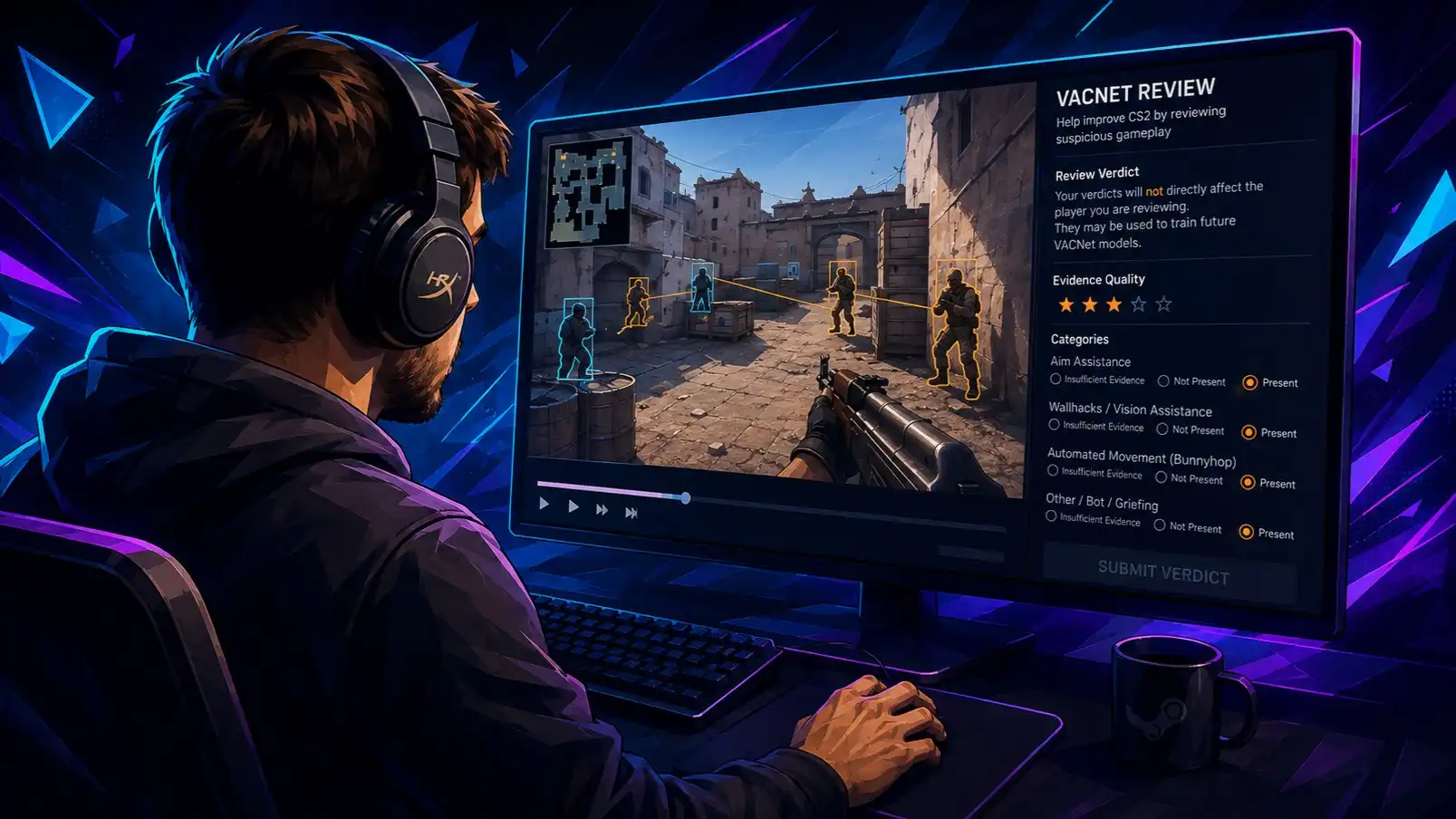
Valve has introduced an Overwatch-style review system for Counter-Strike 2, giving selected users access to a VACNet gameplay-review portal where they can evaluate suspicious clips.
The feature is not currently available to everyone. Access began appearing for selected users around August 11, 2026, following a CS2 update. The portal explains that reviewer decisions do not directly affect the player being observed; instead, submitted labels may be used to train future VACNet models.
The distinction is important. Although the feature resembles the classic CS Overwatch system, the available information suggests Valve is currently using human reviewers primarily as a source of labeled training data rather than as a direct community-powered banning system.
Quick Summary
| Detail | Status |
|---|---|
| Feature | VACNet gameplay review / Overwatch-style system |
| Developer | Valve |
| Game | Counter-Strike 2 |
| Reported rollout | August 11, 2026 |
| Availability | Limited / selected users |
| Main purpose | Review and label suspicious gameplay |
| Direct bans from reviewer verdicts | No, according to portal instructions |
| VACNet training | Yes |
| Full public rollout | TBD |
| Eligibility requirements | Not officially detailed |
Valve has not publicly outlined a complete eligibility formula or confirmed when — or whether — the system will become available to the broader CS2 player base.
What Happened With Valve's New CS2 Review System?
Reports on August 11 revealed that selected Counter-Strike 2 users had gained access to a new gameplay-review feature closely resembling Overwatch, the community moderation system previously available in CS.
Cybersport.ru reported that users can check whether their accounts have access by launching Counter-Strike 2 or visiting the official Counter-Strike website. The outlet also reports that an invitation mechanism exists, although access remains restricted rather than universally available.
Users who receive access are welcomed to a VACNet review portal containing gameplay clips from Counter-Strike matches.
Reviewers are instructed to watch those clips with sound enabled and answer questions about the gameplay they observe.
Crucially, the portal tells reviewers that their verdict will not directly affect the observed player. Instead, the labels may be incorporated into training data for future VACNet models.
That makes the system closer to a human-assisted machine-learning pipeline than a straightforward recreation of CS Overwatch.
How the VACNet Review Portal Works
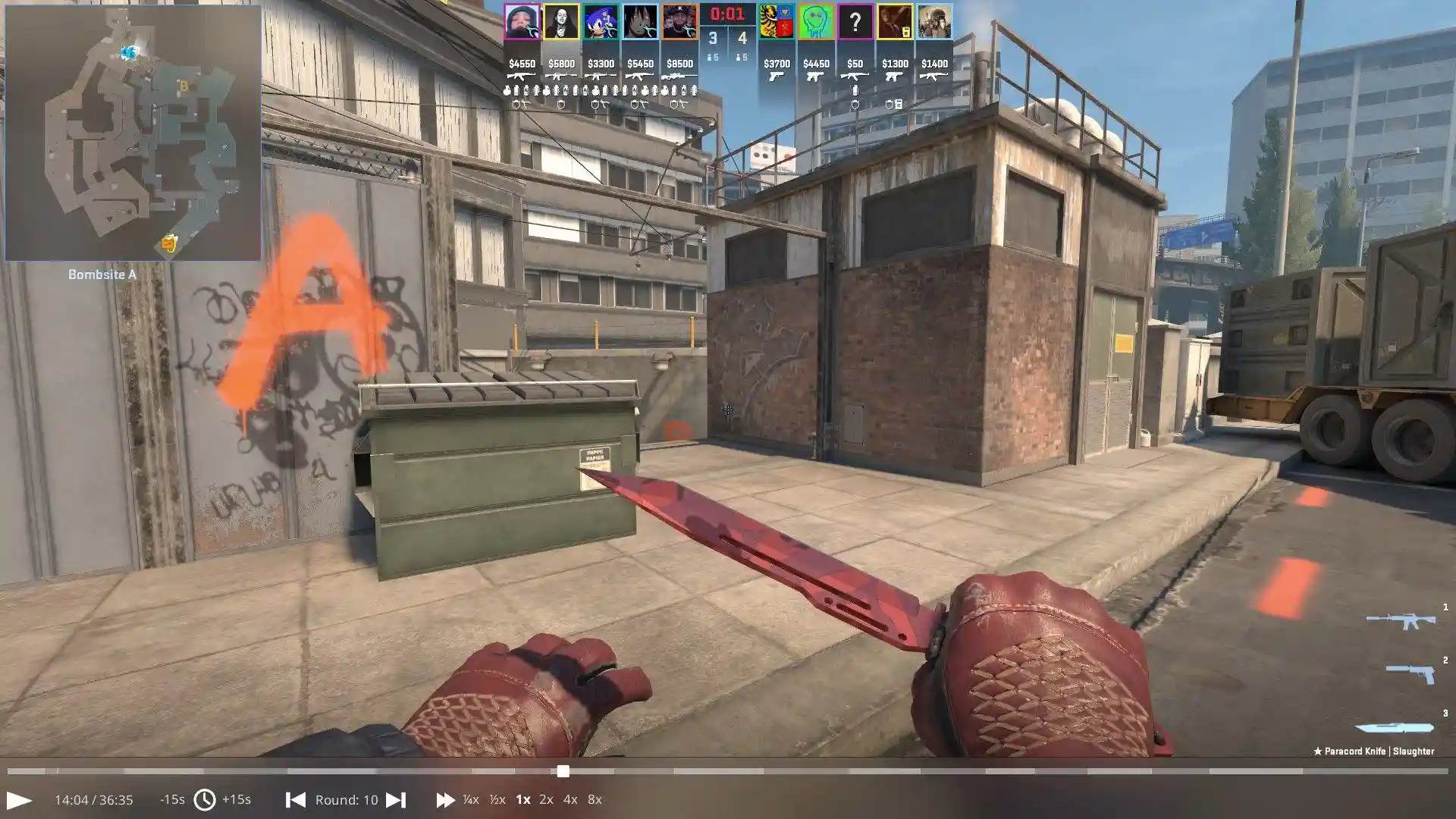
Valve's VACNet Labeling Portal gives selected reviewers access to suspicious gameplay clips used to improve future anti-cheat models.
Additional reporting indicates that reviewers are asked to classify suspicious behavior across several categories.
These reportedly include:
Aim assistance;
Wall hacks or vision assistance;
Automated bunny hopping;
Bot or account-farming behavior.
For each category, reviewers can indicate that cheating appears to be present, that there is insufficient evidence, or that the suspicious behavior is absent. Sport.ua independently reported the same four-category structure.
The portal specifically encourages reviewers to use an uncertain verdict when the available evidence is inconclusive.
That is significant because Valve appears to be prioritizing reliable labels rather than encouraging reviewers to make a binary guilty-or-innocent decision on every clip.
Why Valve Is Using Human Reviewers
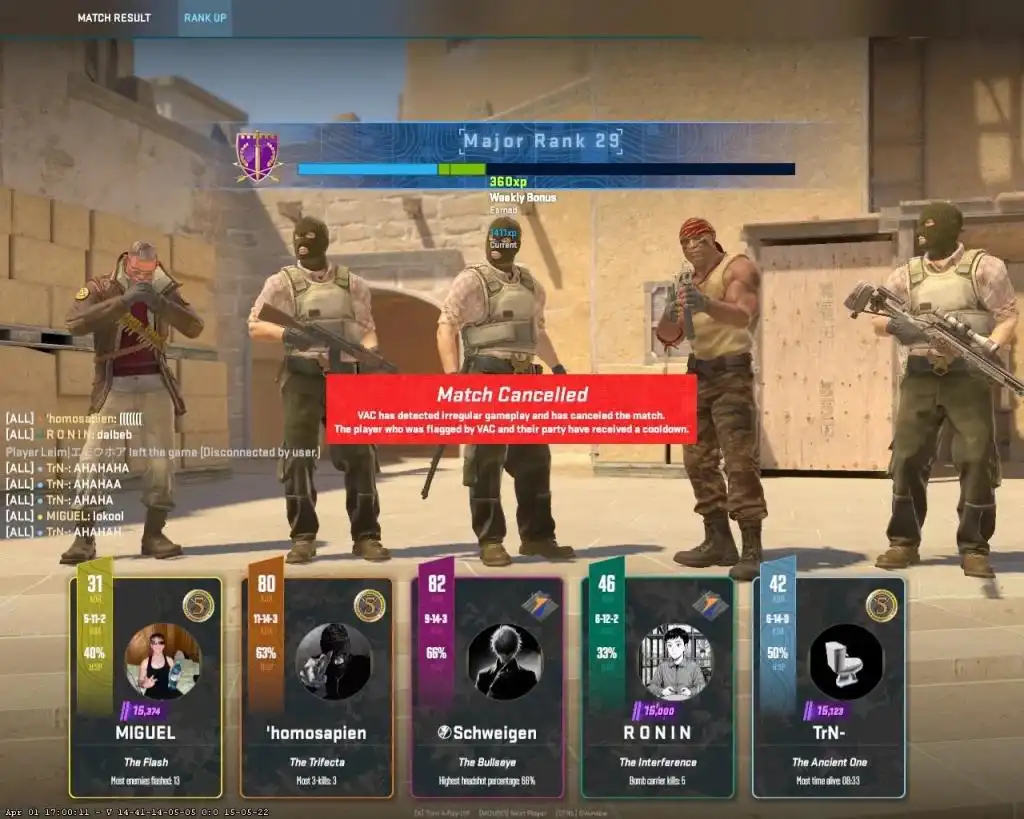
Human-reviewed gameplay labels could help Valve train future VACNet models to recognize suspicious behavior more accurately.
The most important element of the update is its relationship with VACNet.
The portal states that reviewer labels may be used to train future VACNet models. In practical terms, selected players are helping Valve categorize examples of suspicious and legitimate gameplay that could potentially improve automated detection later.
This creates a feedback loop:
Suspicious gameplay → human review → behavioral labels → VACNet training data → future automated detection
That does not mean every reviewed clip will produce a ban.
In fact, Valve's own portal instructions, as reproduced by Cybersport.ru, explicitly say that the reviewer's decision will not directly affect the player being watched.
The immediate value therefore appears to be data collection and model improvement rather than enforcement.
Valve Also Wants Review Clips Kept Private
Valve is asking reviewers not to stream, record, or distribute footage presented through the review portal.
The stated reason is anti-cheat security: publicly exposing the examples being evaluated could potentially help cheat developers understand which behaviors are being identified and adapt their software accordingly.
For content creators, this makes the new system notably different from the old culture surrounding CS Overwatch, where reviewing suspicious cases became a popular streaming and YouTube format.
Unless Valve changes its guidance, creators with access should avoid publicly sharing review footage.
Background: What Was Overwatch in CS?
Overwatch was one of CS's most recognizable community moderation features.
Eligible players could review anonymized match demos involving suspected cheaters and assess whether there was sufficient evidence of different forms of cheating or disruptive behavior.
The new CS2 implementation retains the fundamental idea of experienced players reviewing suspicious gameplay, but its apparent purpose is different.
CS Overwatch vs. CS2 VACNet Review Portal
| Feature | CS Overwatch | CS2 Review Portal |
| Human gameplay review | Yes | Yes |
| Suspicious-player footage | Yes | Yes |
| Community participation | Yes | Limited selected users |
| Reviewer verdict tied to enforcement | Historically part of Overwatch process | Not directly |
| Machine-learning training focus | VACNet was connected to anti-cheat development | Explicitly stated |
| Browser-based review | No / traditional game workflow | Reportedly yes |
| Public clip sharing encouraged | No official requirement to share | Valve explicitly asks users not to share |
| Broad availability | Eligibility-based | Currently limited |
| Full rollout date | N/A | TBD |
The comparison shows why describing the feature simply as "Overwatch returning" may be misleading.
It is better understood, based on the information currently available, as an Overwatch-inspired VACNet labeling system.
Timeline
| Date | Development |
| CS era | Valve operates Overwatch as a community gameplay-review system |
| September 2023 | Counter-Strike 2 replaces CS |
| CS2 era | Traditional player-facing Overwatch is not broadly available |
| July–August 2026 | Community discussion and reports increasingly point toward renewed Overwatch/VACNet activity |
| August 10, 2026 | Community reports highlight evidence of a browser-based Overwatch-style system |
| August 11, 2026 | Selected players reportedly begin receiving access to the VACNet review portal |
| Future | Wider availability and VACNet impact remain TBD |
Community discussion about the browser-based system intensified shortly before the reported rollout. A Reddit thread on August 10 discussed a URL reportedly discovered in game files, while screenshots and reports of invitations appeared on August 11. These community findings should be treated as supporting context rather than equivalent to an official Valve announcement.
Why This CS2 Update Matters
The significance of the update goes beyond the return of a familiar CS feature.
If the labels generated by reviewers are successfully incorporated into VACNet training, Valve could gain a continuously refreshed source of human-classified examples reflecting modern cheating techniques.
That could be particularly useful because cheat behavior changes over time.
A machine-learning detection system ultimately depends on the quality and relevance of the examples used to train and evaluate it. Human reviewers can potentially provide additional context in ambiguous situations where suspicious statistical behavior alone does not prove cheating.
However, this remains potential rather than a demonstrated outcome.
There is currently no verified evidence showing how much the new review portal will improve VACNet detection rates, reduce cheating in Premier, or affect false-positive rates.
Those results will have to be measured over time.
Impact Analysis
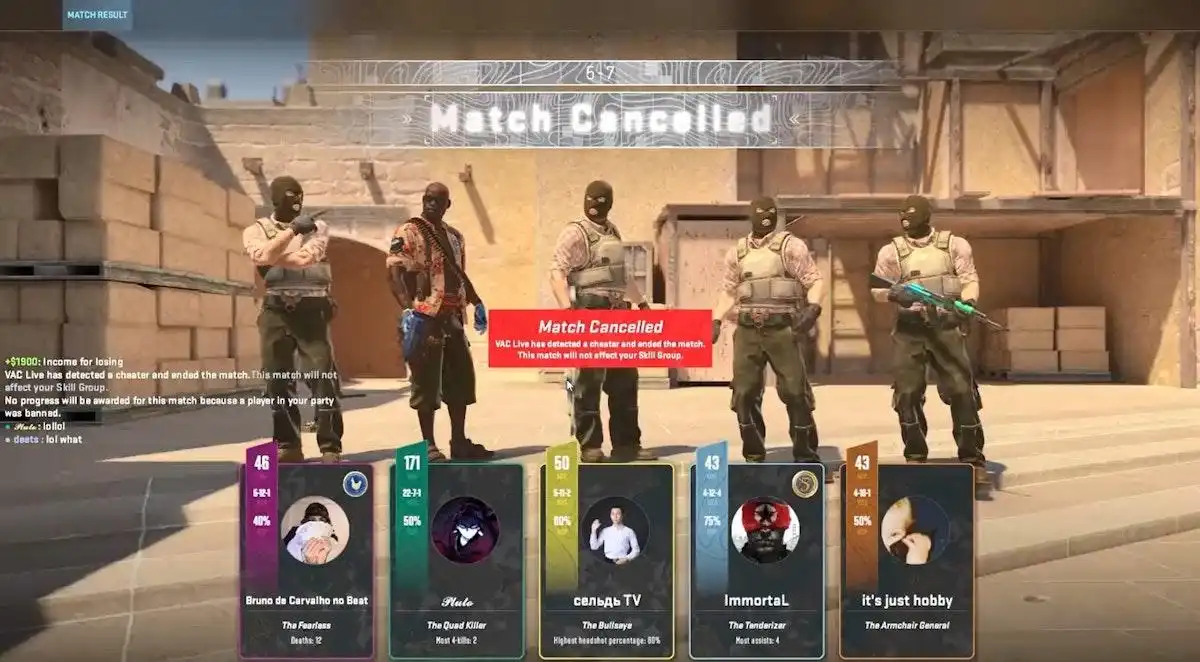
Valve continues to develop its anti-cheat ecosystem around VAC, VAC Live and machine-learning-based VACNet technology.
For Regular CS2 Players
Most players may notice no immediate difference.
Because access is restricted and reviewer verdicts do not directly punish suspects, the system should not be interpreted as an instant solution to cheating in matchmaking.
Its effects — if successful — are more likely to appear gradually through future VACNet improvements.
For Selected Reviewers
Users granted access effectively become human data labelers for Valve's anti-cheat ecosystem.
Accuracy matters more than volume.
Valve's instructions specifically indicate that uncertainty is acceptable, meaning reviewers should avoid declaring suspicious behavior when the evidence is ambiguous.
For Cheat Developers
Valve's request that review footage remain private suggests the company wants to limit information leakage about what VACNet's training pipeline is examining.
Whether this meaningfully complicates cheat development remains unknown.
For Competitive CS2
There is no confirmed direct tournament impact.
Professional events generally operate with their own competitive infrastructure and anti-cheat procedures, so this development is primarily relevant to Valve's matchmaking ecosystem rather than tournament administration.
VRS Impact
None confirmed.
There is no evidence that the review system directly changes Valve Regional Standings calculations or professional team rankings.
What Changes Now?
For most CS2 users, nothing changes immediately.
Selected accounts can participate in gameplay review and provide labels that may contribute to future VACNet development.
Players without access do not currently appear to have a standard method of manually enabling the feature.
Cybersport.ru reports that users can check their eligibility through Counter-Strike itself or the official website, while invitations may also play a role in expanding access.
Valve has not publicly disclosed the complete criteria used to select reviewers.
Community Reaction: Excitement Mixed With Skepticism
Early community reaction has been mixed.
Some players welcomed the apparent return of human review and interpreted it as evidence that Valve is investing further in VACNet. Others questioned whether a limited-access labeling portal will produce noticeable improvements in everyday Premier matchmaking.
Discussion also focused heavily on how reviewers are selected and whether the system will eventually expand.
A popular GlobalOffensive discussion about the new interface accumulated hundreds of votes on August 11, with users debating the browser-based design and its role in training VACNet. Another CS2 discussion centered on the limited invitation process.
These reactions represent community opinion rather than evidence about the system's effectiveness.
Historical Comparison: Overwatch Has Changed Roles
The evolution of Overwatch reflects a broader shift in Valve's anti-cheat strategy.
The traditional concept was:
Humans investigate suspects.
The emerging CS2 concept appears closer to:
Humans provide reliable examples that help automated systems identify suspects.
That is a meaningful architectural difference.
Instead of attempting to scale anti-cheat enforcement by recruiting more human investigators, Valve can potentially use a smaller group of trusted reviewers to improve automated systems capable of analyzing far more matches.
Whether that strategy works depends heavily on reviewer selection, label quality, VACNet performance, and Valve's implementation.
What to Watch Next
Several unanswered questions will determine whether the new system becomes an important part of CS2's anti-cheat infrastructure.
Wider rollout: Valve has not announced when more players will receive access.
Reviewer requirements: The company has not publicly detailed the account age, playtime, rank, Trust Factor, matchmaking history, or other criteria that determine eligibility.
Invitation system: Reports indicate existing reviewers may eventually be able to invite others, but the complete rules and limitations require further confirmation.
VACNet results: The biggest question is whether the newly collected labels lead to measurable improvements in cheat detection.
Enforcement changes: Valve could eventually connect the review pipeline to additional automated or manual enforcement systems, but no such expansion should be assumed until confirmed.
Official documentation: A detailed Valve announcement explaining the architecture would clarify how closely the new system should actually be compared with classic Overwatch.
FAQ
Did Valve bring Overwatch back to CS2?
An Overwatch-style gameplay review feature is now reportedly available to selected CS2 users. However, it is not identical to traditional CS Overwatch. The current portal states that reviewer labels may be used to train future VACNet models rather than directly punish the player being reviewed.
Can everyone access CS2 Overwatch?
No. Access is currently limited to selected users, according to reports published on August 11, 2026. Valve has not disclosed complete eligibility requirements.
Can reviewers ban cheaters?
Not directly. The portal specifically states that a reviewer's verdict does not directly affect the observed player. Instead, the submitted labels may be used for future VACNet training.
How do I know if I have access?
Cybersport.ru reports that players can check through Counter-Strike 2 or the official Counter-Strike website. Eligible users should see access to the VACNet review portal.
What is VACNet?
VACNet is part of Valve's anti-cheat technology for Counter-Strike. In the context of the new portal, human-generated labels are explicitly described as potentially being used to train future VACNet models.
Related News