

dastan Reveals Coaching Changes as PARIVISION Target CS2 Consistency
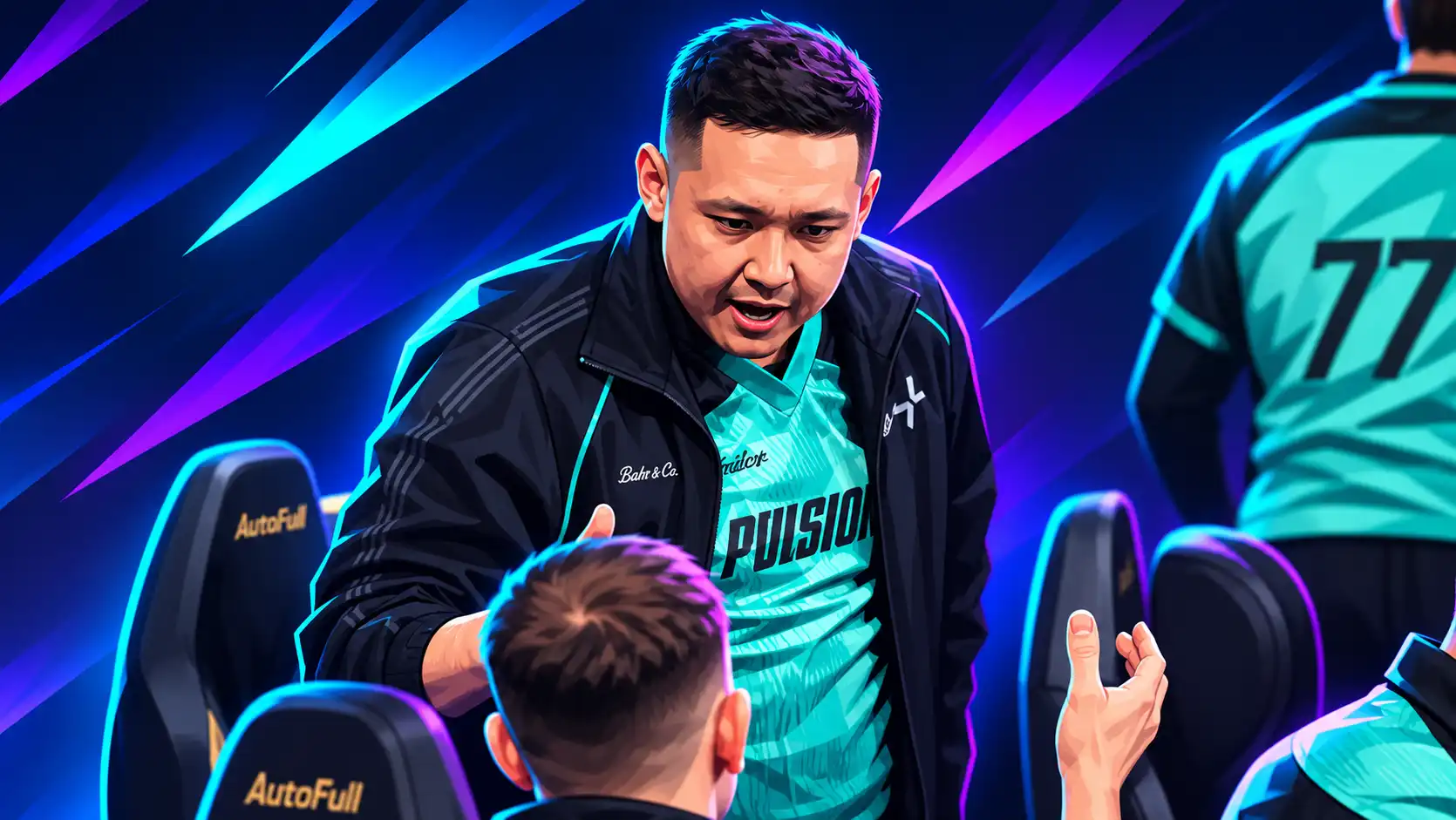
PARIVISION coach Dastan 'dastan' Akbayev has revealed how he is changing his approach to leadership, emotional control and in-game communication as his team attempts to establish itself among Counter-Strike 2's most consistent competitors.
Speaking to HLTV after PARIVISION's comeback victory over G2 Esports at IEM Beijing 2026 on November 2, the Kazakh coach acknowledged that recent experiences had forced him to reconsider how he manages pressure and communicates with his players.
The adjustment follows a difficult period surrounding PARIVISION's Major qualification and a stressful final in Belgrade. With experienced figures such as Jame, FL1T and HObbit now contributing to the team's leadership structure, dastan believes PARIVISION has an opportunity to build a more sustainable competitive environment.
Rather than measuring progress exclusively through trophies, the coach has identified consistent performances and closing the gap to the world's top 10 as his central objectives.
Quick summary
Confirmed: dastan publicly discussed changing his emotional approach in an HLTV interview published November 2, 2026.
Leadership: Jame, FL1T and HObbit are helping distribute responsibility within PARIVISION.
Tournament: PARIVISION opened IEM Beijing 2026 by defeating G2 in a best-of-three reverse sweep.
Objective: More reliable tier-one results and progress toward the top 10, rather than an immediate demand for titles.
Status: Direct coach statements, with subsequent comments from FL1T supporting the account of an ongoing adjustment.
Why dastan is changing his coaching approach
The central revelation from dastan's interview was not a new strategy, roster move or tournament prediction. It was an admission that his own behavior needed to evolve alongside PARIVISION's changing lineup.
After PARIVISION's opening victory against G2, dastan explained that he had made a deliberate effort to control his reactions following the first map. Rather than allowing frustration to dominate his communication, he attempted to speak differently to the players and maintain a more constructive atmosphere.
The coach summarized that effort with a short statement:
"I worked on myself not to show a bad mood."
The comment reflects a broader reassessment of how he responds to difficult matches. Dastan identified the final in Belgrade, played after PARIVISION secured Major qualification, as an important moment in that process.
He acknowledged struggling to manage his emotions during that final after a demanding sequence of matches. Subsequent internal discussions helped him recognize that the team's changing composition required a different leadership approach.
This is not a claim that PARIVISION has abandoned demanding coaching standards. Instead, dastan described an attempt to balance accountability with a more controlled emotional response.
He also emphasized that he remains prepared to take direct responsibility when the team's performance requires intervention.
The distinction matters: PARIVISION's coaching adjustment is about how authority is exercised, not whether authority exists.
PARIVISION's experienced core is reshaping team leadership
One of the most important changes in PARIVISION's current setup is the presence of multiple established Counter-Strike veterans.
Dastan specifically identified three players who can share responsibility for communication, discipline and decision-making:
-
Dzhami "Jame" Ali: An experienced leader whose tactical understanding provides an important reference point for the team.
-
Evgenii "FL1T" Lebedev: A veteran player who can contribute to discussions about execution, preparation and team structure.
-
Abay "HObbit" Khassenov: An experienced competitor with a background in Gambit, bringing another perspective on team systems and high-level competition.
Dastan contrasted this environment with his previous work alongside younger players such as nota, BELCHONOKK and AW.
Managing developing players can place greater responsibility on the coach to establish standards, correct mistakes and guide decision-making. A more experienced roster potentially allows those responsibilities to be shared.
For PARIVISION, the potential benefit is not simply having more recognizable names. It is the possibility of creating a team in which tactical understanding and accountability are distributed across several players.
However, that experience may introduce trade-offs. Dastan acknowledged that the lineup could sacrifice some raw mechanical explosiveness in certain attacking situations while gaining a better collective understanding of the game.
Whether that exchange produces more consistent results remains an open competitive question.
IEM Beijing 2026: How the G2 comeback tested PARIVISION
PARIVISION's opening match against G2 Esports provided an immediate example of the pressure dastan was attempting to manage differently.
After losing the opening map, PARIVISION recovered to win the series. G2 then threatened a comeback on Ancient, but PARIVISION held on to complete the reverse sweep.
The match also revealed an aggressive approach to tactical timeouts.
According to the HLTV interview, PARIVISION had already exhausted its timeouts on Dust2 by the time the score reached 6-2. On Ancient, the team had used all its pauses within the first six rounds.
Dastan explained that these early interventions were intentional rather than the result of a predetermined timeout schedule.
He believed PARIVISION's relatively limited recent official-match activity made it difficult for the team to establish its rhythm immediately. Early rounds therefore became an opportunity to correct mistakes before they developed into larger problems.
His explanation also highlighted an important coaching principle: tactical pauses are not necessarily most valuable when a match is close. Sometimes they are used to establish control before the opponent can build momentum.
Why PARIVISION used its tactical pauses so early
Three factors help explain dastan's approach.
1. Limited competitive rhythm
Dastan compared PARIVISION's recent schedule with teams that regularly compete in lower-tier tournaments and accumulate substantially more official maps.
A team returning from a break may need time to adjust to the intensity and decision-making speed of tournament competition.
2. The importance of opening rounds
Pistol rounds and early-round sequences can influence the economy and direction of a map. Dastan wanted to address problems immediately rather than wait for a larger deficit.
3. Greater responsibility for players
On Ancient, PARIVISION built a 10-2 lead before G2 began recovering. With no pauses remaining, the players had to manage the closing stages themselves.
Dastan accepted that responsibility, explaining that the team needed to finish the map without further coaching intervention.
This created an interesting contrast: while PARIVISION's coach was heavily involved early, the players ultimately had to demonstrate independence under pressure.
The victory was encouraging, but a single series cannot establish whether the new approach will produce long-term consistency.
Background: From AVANGAR and Virtus.pro to PARIVISION
Dastan's comments carry additional significance because his coaching philosophy has developed across several competitive eras.
His career includes work with AVANGAR, Virtus.pro and PARIVISION, giving him experience with different rosters and competitive expectations.
In the interview, he identified a recurring pattern across those projects: teams capable of performing well in important matches, particularly around Major qualification, but less reliable at ordinary tournaments.
That distinction helps explain why he is now emphasizing consistency.
A roster that occasionally defeats elite opponents can demonstrate a high competitive ceiling. However, regularly reaching playoffs requires that standard to be reproduced across different opponents, tournament formats and preparation conditions.
PARIVISION's recent development has also involved adjustments to its roster and competitive identity.
The arrival of FL1T and the return of HObbit to the active lineup added experienced voices to a project that had previously relied more heavily on younger players.
For dastan, the challenge is to combine that experience with a coherent system rather than assume veteran players will automatically solve the team's problems.
Building a simpler, more adaptable system
Dastan also addressed comments from HObbit suggesting that PARIVISION's system could become overly extensive.
The coach explained that the team is still establishing its working standards, including how it prepares for matches, structures practice, interprets maps and decides which rounds deserve particular attention.
These details become especially important during demanding tournament schedules.
Travel, short practice windows and limited recovery time can affect preparation. A system that works under ideal conditions may be harder to execute when a team has only a few days to practice.
The implication is that PARIVISION needs not only tactical depth but also clear priorities.
A well-defined system could help experienced players make faster decisions without requiring constant intervention from the coach. This is a potential benefit of the adjustment, rather than a confirmed outcome.
Timeline: PARIVISION's coaching and leadership transition
|
Date / period |
Development |
Significance |
|---|---|---|
|
Earlier PARIVISION period |
dastan works with younger players including nota, BELCHONOKK and AW |
Establishes the background to his more hands-on coaching style |
|
July 2026 |
FL1T joins PARIVISION |
Adds another experienced player to the project |
|
September 2026 |
HObbit returns to the active lineup |
Strengthens the veteran presence |
|
Before November 2, 2026 |
PARIVISION secure Major qualification and play a stressful final in Belgrade |
Dastan identifies his emotional response as a reason to reconsider his approach |
|
November 2, 2026 |
PARIVISION defeat G2 at IEM Beijing |
Provides an early competitive test of his adjusted communication style |
|
November 2, 2026 |
HLTV publishes dastan's interview |
The coach publicly explains his change in approach |
|
November 7, 2026 |
FL1T discusses PARIVISION's progress following its Beijing quarter-final defeat to NAVI |
Offers a player's perspective on the ongoing coaching changes |
The timeline combines dastan's November 2 interview, HLTV's player coverage and FL1T's November 7 follow-up.
PARIVISION CS2 roster and leadership structure
The following lineup is identified in HLTV's November 2026 coverage.
|
Member |
Position / function |
Relevance to the coaching changes |
|---|---|---|
|
Jame |
Player, AWPer and experienced leader |
Helps with tactical discussions and shared responsibility |
|
FL1T |
Player |
Adds experience and another communication voice |
|
HObbit |
Player |
Contributes experience and feedback on team systems |
|
xiELO |
Player |
Part of the team's competitive development |
|
zweih |
Player |
Part of the team's competitive development |
|
dastan |
Head coach |
Oversees preparation, tactical intervention and team environment |
The specific distribution of responsibilities between the five players has not been formally detailed. This table should not be interpreted as an announcement of new official team roles.
Key details: dastan's PARIVISION interview
|
Detail |
Verified information |
|---|---|
|
Main subject |
Dastan Akbayev's coaching approach |
|
Team |
PARIVISION |
|
Event |
IEM Beijing 2026 |
|
Interview publication |
November 2, 2026 |
|
Interview source |
HLTV, by Nohte |
|
Match discussed |
PARIVISION vs G2 |
|
Result |
PARIVISION reverse-sweep victory |
|
Main trigger for reflection |
Emotional difficulties during the Belgrade final |
|
Leadership contributors |
Jame, FL1T, HObbit |
|
Tactical focus |
Early-round intervention, timeouts and preparation |
|
Competitive objective |
More consistent tier-one results and progress toward the top 10 |
|
Formal coaching replacement |
None announced |
|
Official new leadership hierarchy |
TBD |
|
Next tournament after Beijing |
TBD from the verified sources used here |
|
Direct evidence of improved long-term results |
Not yet established |
Why dastan's comments matter for PARIVISION
The interview provides a useful perspective on an issue that is often overlooked in professional Counter-Strike: the relationship between coaching behavior and competitive stability.
Much of the public discussion around CS2 performance focuses on player ratings, map pools, roster transfers and tactical execution. Dastan's comments suggest that team communication and emotional management are also central concerns within PARIVISION.
Three areas are particularly relevant.
1. Consistency is becoming a more important benchmark than isolated victories
Dastan made clear that winning an individual tournament is not his immediate definition of success.
His stated priority is to make PARIVISION a reliable competitor capable of approaching the world's top 10.
That does not mean the team lacks ambition to win titles. It means that consistently competing at a high level is being treated as an important step toward larger achievements.
2. Leadership can become less dependent on the coach
The presence of Jame, FL1T and HObbit potentially reduces the need for dastan to manage every situation directly.
Experienced players can identify problems, communicate adjustments and maintain standards during periods when the coach cannot intervene.
The G2 match illustrated why that independence matters: once PARIVISION had exhausted its tactical pauses, the players were responsible for closing the map.
3. Emotional control may improve the quality of communication
A coach's reaction to mistakes can influence how players interpret feedback during a match.
More measured communication could help players remain focused on actionable information rather than the frustration surrounding a lost round.
However, this is a plausible benefit, not a statistically demonstrated improvement in PARIVISION's performance.
The longer-term effect will need to be assessed through results and further player feedback.
Tactical impact analysis: What could change inside the server?
Dastan's comments point toward several possible developments in PARIVISION's gameplay.
|
Area |
Current evidence |
Potential impact |
|---|---|---|
|
Early-round preparation |
Coach emphasizes pistol rounds and early map momentum |
Faster identification of tactical problems |
|
Timeout management |
Aggressive early timeout usage against G2 |
Better early adjustments, but fewer pauses available late |
|
Mid-round communication |
More experienced voices in the roster |
Potentially faster decisions under pressure |
|
T-side execution |
Dastan acknowledges a possible reduction in raw aim |
Greater reliance on coordination and structure |
|
Team preparation |
Internal discussions about work standards and system complexity |
More consistent preparation across events |
|
Pressure management |
Coach actively working to control emotional reactions |
Potentially more stable communication during difficult matches |
These are analytical interpretations of the coach's statements, not confirmed changes to PARIVISION's playbook.
The risk of using tactical pauses too early
The G2 series also exposed a potential weakness.
Using every available pause during the opening stages can leave a team without direct coaching intervention when an opponent begins recovering.
That was particularly relevant on Ancient, where G2 threatened PARIVISION's substantial lead.
The approach may be effective when early adjustments establish control, but it also places greater demands on players during the closing rounds.
Future matches should help clarify whether dastan continues to favor early intervention or adopts a more flexible distribution of tactical timeouts.
Tournament impact: Did the coaching adjustment improve results?
The G2 victory was a positive opening result, but PARIVISION's subsequent IEM Beijing campaign offers a more complete picture.
The team eventually reached the quarter-finals, where it was eliminated by Natus Vincere.
In an interview published November 7, FL1T described the defeat as frustrating while expressing optimism about PARIVISION's overall development.
He also confirmed that dastan had been making a significant effort to control his emotions and adjust his relationship with the players.
This additional perspective is important because it supports the existence of the coaching adjustment beyond dastan's own account.
It does not, however, establish that the adjustment directly caused any particular match result.
The Beijing campaign therefore represents both progress and an unresolved challenge: PARIVISION demonstrated its ability to recover against G2 but still fell short of a deeper playoff run.
Ranking and Valve Regional Standings implications
Dastan's stated ambition of approaching the top 10 creates a clear competitive benchmark.
However, his comments should not be interpreted as confirmation that PARIVISION has reached a particular ranking threshold.
The interview does not provide a verified before-and-after ranking comparison attributable to the coaching adjustment.
Similarly, it does not establish a measurable change in PARIVISION's Valve Regional Standings position.
The potential ranking implications are therefore indirect.
If PARIVISION can regularly defeat stronger opposition, qualify for playoffs and avoid early tournament exits, those results could improve its competitive standing over time.
Verified ranking movement caused by the coaching changes: TBD.
For an updated assessment, readers should consult the latest PARIVISION team profile on HLTV and official Valve Regional Standings data rather than treating the coach's top-10 ambition as an achieved result.
What changes now for PARIVISION?
The immediate change is not a new roster announcement or an officially revised coaching position. It is an adjustment to how PARIVISION intends to operate as a team.
Dastan remains responsible for the team's preparation and performance, but he is attempting to create an environment in which experienced players can take a more active role in maintaining standards.
That approach could produce several practical differences.
First, Jame, FL1T and HObbit may increasingly contribute to discussions about tactical decisions, preparation and mistakes.
Second, the coaching staff and players will need to determine which parts of PARIVISION's system are essential and which can be simplified.
Third, the team will need to find a balance between proactive coaching interventions and preserving tactical resources for later stages of a match.
Finally, the organization will need to judge progress across multiple events rather than relying on a single impressive victory.
No formal change to the coaching staff or in-game leadership structure has been announced in the verified reporting.
What to watch next
PARIVISION's next tournament
The next confirmed event following Beijing remains TBD in the sources used for this article. The important question is whether PARIVISION can reproduce its competitive level across consecutive events.
Tactical timeout patterns
Watch whether dastan continues using pauses aggressively in the opening rounds or saves more interventions for late-map pressure.
Communication between veterans and younger players
Further interviews could reveal whether the experienced core is helping PARIVISION simplify its system and improve decision-making.
Playoff consistency and ranking progress
Repeated playoff appearances and sustained results against leading teams will provide stronger evidence of progress than individual upset victories.
Related CS2 teams, players and events
|
Entity |
Connection to the story |
|---|---|
|
PARIVISION |
The team implementing dastan's coaching adjustments |
|
dastan |
Head coach and central interview subject |
|
G2 Esports |
PARIVISION's opening opponent at IEM Beijing |
|
Natus Vincere |
Eliminated PARIVISION in the Beijing quarter-finals |
|
IEM Beijing 2026 |
Tournament where dastan discussed his new approach |
|
Virtus.pro |
Part of dastan's previous coaching history |
|
AVANGAR |
Another organization associated with dastan's career |
|
Gambit Esports |
Relevant to HObbit's competitive experience |
FAQ: dastan and PARIVISION's coaching changes
Why did dastan decide to change his coaching style?
Dastan said he struggled to control his emotions during a stressful final in Belgrade after PARIVISION qualified for the Major. Subsequent discussions with the team convinced him that he needed to adjust his approach.
Is dastan leaving PARIVISION?
No departure was announced in the verified reporting. The interview concerns changes to his communication and leadership style, not a coaching replacement.
How are Jame, FL1T and HObbit helping dastan?
Their experience allows them to contribute to tactical discussions, preparation and team accountability. Dastan believes this can help distribute responsibility more effectively.
What happened in PARIVISION's match against G2 at IEM Beijing 2026?
PARIVISION recovered from losing the first map to win the best-of-three series. G2 threatened a comeback on Ancient, but PARIVISION held on to secure the victory.
What is dastan's main goal for PARIVISION?
He wants the team to become more consistent against tier-one opposition and move closer to the world's top 10. Tournament victories remain desirable, but he is prioritizing sustainable improvement.
Related News


.webp)