
CS2 Update Adds Silent Reloading: How Valve’s New Mechanic Changes Gameplay

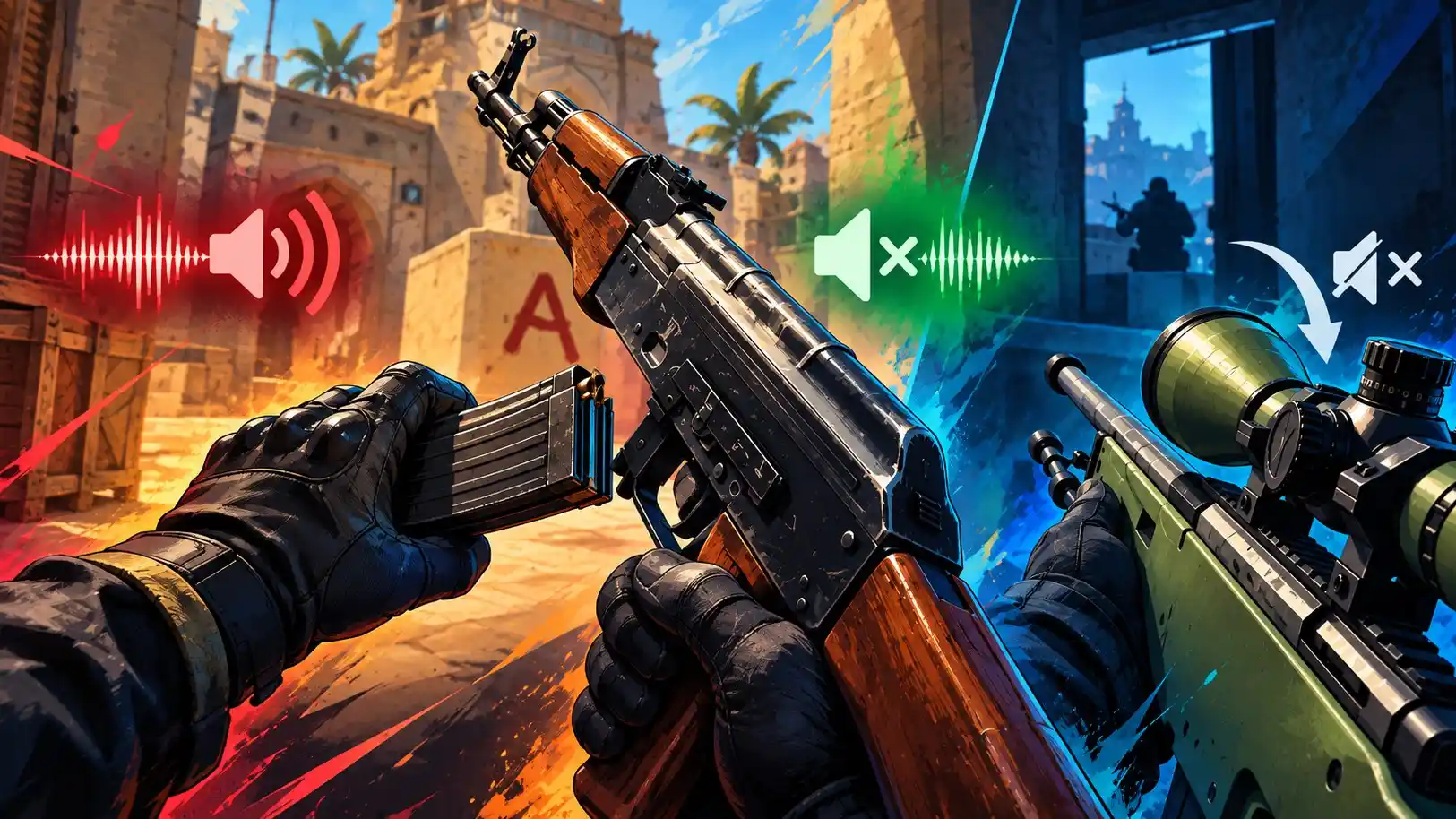
Valve has introduced silent reloading in its September 22 Counter-Strike 2 update, adding a new tactical option that could change how players approach clutch situations, lurking and information gathering. The mechanic allows players to reload without producing the usual sound, but there is a trade-off: the process takes longer.
The CS2 update also removes the sound produced when unscoping a sniper rifle, potentially changing how players interpret audio information during competitive matches. The changes have already prompted contrasting reactions from professional players, analysts and the wider Counter-Strike community.
CS2 Silent Reload Update
|
Detail |
Information |
|---|---|
|
Developer |
Valve |
|
Release date |
September 22, 2026 |
|
Main change |
Optional silent reloading |
|
How to activate |
Press and hold the reload key |
|
Trade-off |
Slower reload |
|
Additional change |
Silent sniper unscoping |
|
Most relevant situations |
Clutches, lurking and defensive holds |
|
Competitive impact |
Potential changes to audio-based decisions |
|
Professional meta |
Still developing |
Verified against Valve's official patch notes. Tactical implications are editorial analysis, not confirmed competitive outcomes.
What happened in the September CS2 update?
Valve released an update on September 22 that changes two established sources of audio information in Counter-Strike 2: weapon reloading and sniper unscoping.
Previously, hearing an opponent reload could create an opportunity to push while their weapon was temporarily unavailable. With the new mechanic, a player can choose a slower but silent reload instead, denying the opponent that particular audio cue.
The change does not eliminate the standard reload. Instead, it introduces an additional decision: reload quickly and risk revealing information, or reload quietly and remain vulnerable for longer.
Valve also removed the sound associated with unscoping sniper weapons. This means an opponent can no longer rely on that specific sound to determine whether a sniper has stopped aiming down their scope.
How silent reloading works in CS2

Standard reload
Press the reload key normally. The weapon uses its regular reload animation and produces the usual sound, which nearby opponents may hear.
Silent reload
Press and hold the reload key. The weapon reloads more slowly, but without the normal reload sound. This can prevent nearby opponents from identifying the reload through audio.Valve has not published a complete weapon-by-weapon comparison of the two reload speeds in the September 22 patch notes. Exact timing differences for individual weapons should therefore be established through controlled testing rather than estimated.
Silent reloading also does not make the player invisible or eliminate other sources of information. Opponents may still infer a reload from previous shots, positioning, movement or direct visual contact.
Why did Valve add silent reloading?
Valve's official patch notes explain how silent reloading works but do not provide a detailed statement of the design philosophy behind the mechanic. However, the change introduces a new trade-off between speed and information.
A player must now decide whether maintaining concealment is worth spending additional time reloading.
There are three possible design implications:
-
More tactical options: Players can choose a reload method according to their immediate situation rather than always using the same animation.
-
Greater uncertainty: Opponents can no longer assume that the absence of a reload sound means a weapon has not been reloaded.
-
Additional decision-making: Players must balance ammunition, time, positioning and the possibility of an opponent pushing.
These are potential gameplay consequences, not confirmed statements of Valve's intentions.
Background: Valve's earlier ammunition changes
The September update follows another significant adjustment to CS2's ammunition system.
On March 18, 2026, Valve changed magazine-fed weapon reloading so that ammunition remaining in a discarded magazine is lost. The update also introduced revised reserve-ammunition displays and adjusted reserve magazine counts.
Together, the March and September changes create two separate considerations: how much ammunition a player can afford to discard and how much information they are willing to reveal while reloading.
CS2 update timeline
|
Date |
Development |
Significance |
|---|---|---|
|
March 18, 2026 |
Magazine-based ammunition changes |
Reloading requires more careful ammunition management. |
|
September 22, 2026 |
Silent reloading introduced |
Players gain a slower, quieter reload option. |
|
September 22, 2026 |
Silent sniper unscoping |
Removes an established audio cue. |
|
September 24, 2026 |
Competitive debate develops |
Players and analysts discuss possible effects on clutch situations. |
|
TBD |
Longer-term competitive adaptation |
Tournament evidence is needed to establish the actual impact. |
The March and September changes are documented in Valve's official update history; the September 24 discussion is covered by Cybersport.ru.
Why silent reloading matters for competitive CS2
Counter-Strike is built around incomplete information. Footsteps, gunfire, utility sounds and reloads help players reconstruct opponents' positions and make decisions without direct visual contact.
Silent reloading removes one of those signals when a player deliberately chooses the slower animation. Its significance depends heavily on the situation.
Tactical impact by situation
|
Situation |
Potential effect |
| 1v1 clutch | An opponent may have less information about when it is safe to push. |
| Lurking | A lurker may replenish ammunition without revealing their position through a reload sound. |
| Site anchoring | A defender may reload without giving attackers an obvious audio cue to execute a push. |
| Post-plant | Attackers and defenders gain another option for managing ammunition while concealing their immediate intentions. |
| Fast engagements | The slower animation may be too risky when an opponent can immediately swing. |
1. Clutch situations become less predictable

Consider a hypothetical 1v1 post-plant situation. A defender knows the remaining attacker has fired most of their magazine and is hiding behind cover.
Previously, hearing the attacker reload could provide a valuable opportunity to advance. Now, the attacker may choose to reload silently, forcing the defender to make a decision without that particular cue.
However, a silent reload takes longer. If the defender correctly anticipates the action and pushes immediately, the attacker could be caught before their weapon is ready.
The mechanic therefore changes the information available to both players without removing the risk associated with reloading.
2. Lurkers gain another way to conceal their actions
Lurkers often operate separately from their teammates, exploiting rotations, controlling isolated areas and searching for favorable engagements.
For these players, preserving information is especially important.
A lurker who has fired several shots may be able to replenish ammunition without revealing their presence through a reload sound. That could be useful when holding a flank, maintaining control of a contested area or preparing to catch a rotating opponent.
The longer animation remains a limitation, particularly if the lurker is exposed or has insufficient information about nearby enemies.
3. Site anchors can conceal vulnerable moments
Defensive anchors frequently face difficult ammunition decisions when holding bombsites against multiple attackers.
Silent reloading offers another option when an anchor has temporarily disengaged behind cover.
An attacker who does not hear a reload must consider whether the defender is reloading, holding an angle or preparing to reposition.
Nevertheless, choosing a slower reload during an active site execution may be dangerous. The mechanic is more likely to be useful when a defender has sufficient cover and time.
4. Sniper unscoping changes audio-based decisions
The same update removes the sound of unscoping sniper weapons.
This could affect how opponents interpret an AWPer's actions. A player who previously used an unscoping sound to infer a sniper's intentions can no longer rely on that cue.
Importantly, silent unscoping does not mean that all sniper actions are silent. Other weapon sounds and movement information remain relevant.
Professional reactions: what players and analysts are saying
The new mechanic has prompted different interpretations of its competitive implications.
According to Cybersport.ru's September 24 coverage, Danil "donk" Kryshkovets welcomed the update's potential for defensive players and those frequently involved in clutch situations. Former professional Andrey "B1ad3" Mekhryakov also discussed the additional possibilities for mind games in situations such as 2v2s, suggesting that the effects may be particularly noticeable at a high level of play.
Team Spirit analyst Anatoly "liTTle" Averyanov expressed a different concern, arguing that silent reloading could remove a difficult ammunition decision from some clutch scenarios.
The disagreement illustrates the central question surrounding the mechanic: does introducing a slower, silent alternative increase tactical depth, or does removing a familiar audio cue reduce the importance of an established skill?
There is not yet enough competitive evidence to establish its long-term effect.
Editorial verification note: The source identifies former player Andrey Mekhryakov and Team Spirit analyst Anatoly Averkov. Their nicknames should not be inferred from those names. In the reactions section above, remove the nickname associations for Mekhryakov and Averkov; the cited opinions belong to those named individuals. Cybersport.ru also attributes its positive player reaction to Danil Kryshkovets.
Tournament impact: what could change in professional matches?
The most useful evidence will come from situations where a team has enough information to anticipate an opponent's ammunition count but cannot directly observe their reload.
Professional teams may adapt by incorporating silent reloads into post-plant protocols, defensive holds and late-round rotations. They may also develop ways to exploit the longer animation through coordinated pushes or utility.
Three aspects are particularly worth examining in upcoming tournament demos: how often players select silent rather than standard reloading, whether opponents successfully punish the slower animation, and whether the mechanic changes decisions in late-round engagements.
No reliable tournament-wide usage statistics or measured win-rate effects were available for this article.
Does silent reloading affect Valve Regional Standings?
The update does not directly modify the Valve Regional Standings (VRS) calculation. Any indirect effect on rankings would depend on actual match results, rather than the mechanic itself. No ranking impact can currently be attributed to silent reloading.
Key details: confirmed mechanics versus open questions
|
Question |
Current status |
|---|---|
|
Is silent reloading officially available? |
Yes |
|
How is it activated? |
Hold the reload key |
|
Is it slower than a normal reload? |
Yes |
|
Does it replace standard reloading? |
No |
|
Are precise weapon-specific timing differences published? |
Not in the initial patch notes |
|
Is sniper unscoping silent? |
Yes |
|
Does the update establish a new professional meta? |
TBD |
|
Will Valve adjust the mechanic further? |
TBD |
What changes now for everyday players?
The immediate adjustment is learning when to use each reload option. A standard reload remains useful when speed is essential, while silent reloading provides an alternative when concealing information is more important.
Players can experiment in practice sessions with different weapons, using a teammate to test whether and when the standard reload can be heard at relevant distances.
The new mechanic should also encourage more careful interpretation of opponents' ammunition. An opponent who has stopped firing may still be holding an angle, reloading silently or waiting for a reaction.
For AWP users, the unscoping change is another reason to reconsider how they manage audio information when disengaging from an angle.
What to watch next
Competitive developments to monitor
-
Professional adoption: Whether players consistently incorporate silent reloading into late-round decisions.
-
Clutch examples: Documented rounds in which the absence of a reload sound materially affects an opponent's decision.
-
Weapon-specific testing: Controlled comparisons of normal and silent reload durations.
-
Balance adjustments: Any future Valve changes to animation speeds, audio behavior or ammunition mechanics.
-
Tournament evidence: Match demos and analysis showing how teams adapt over multiple events.
Related teams, players and events
The update applies across Counter-Strike 2 rather than targeting a particular team or tournament. Team Spirit is relevant to the initial discussion because its player Danil Kryshkovets and analyst Anatoly Averkov were among the individuals whose reactions were covered by Cybersport.ru.
The wider implications are relevant to professional lurkers, defensive anchors, AWPers and in-game leaders across the competitive scene. Specific changes to individual teams' strategies remain unverified.
Suggested related reading for CS2News.com includes coverage of Valve's March ammunition update, the September Premier map-selection changes, the new Rush mode and future professional demonstrations of silent reloading.
FAQ: CS2 silent reloading
How do you reload silently in CS2?
Press and hold your reload key. Your weapon performs a slower reload without the normal reload sound.
Is silent reloading faster than a normal reload?
No. Valve explicitly describes the silent version as slower. The exact difference may vary by weapon and requires controlled testing.
Can enemies hear silent reloading in CS2?
The mechanic is designed to remove the reload sound. Opponents can still obtain information through other sounds, visual contact and deductions based on previous shots.
Does silent reloading make clutch situations easier?
It introduces an additional tactical option, but its effectiveness depends on timing, positioning and ammunition. The longer animation can leave players vulnerable if an opponent pushes at the right moment.
Did Valve also change the AWP?
Yes. The September 22 update removed the sound produced when unscoping sniper weapons, including the AWP. This is separate from the new reload option.
Related News