
CS2 Players Use Insults in Nearly One in Six Matches, New Statistics Show

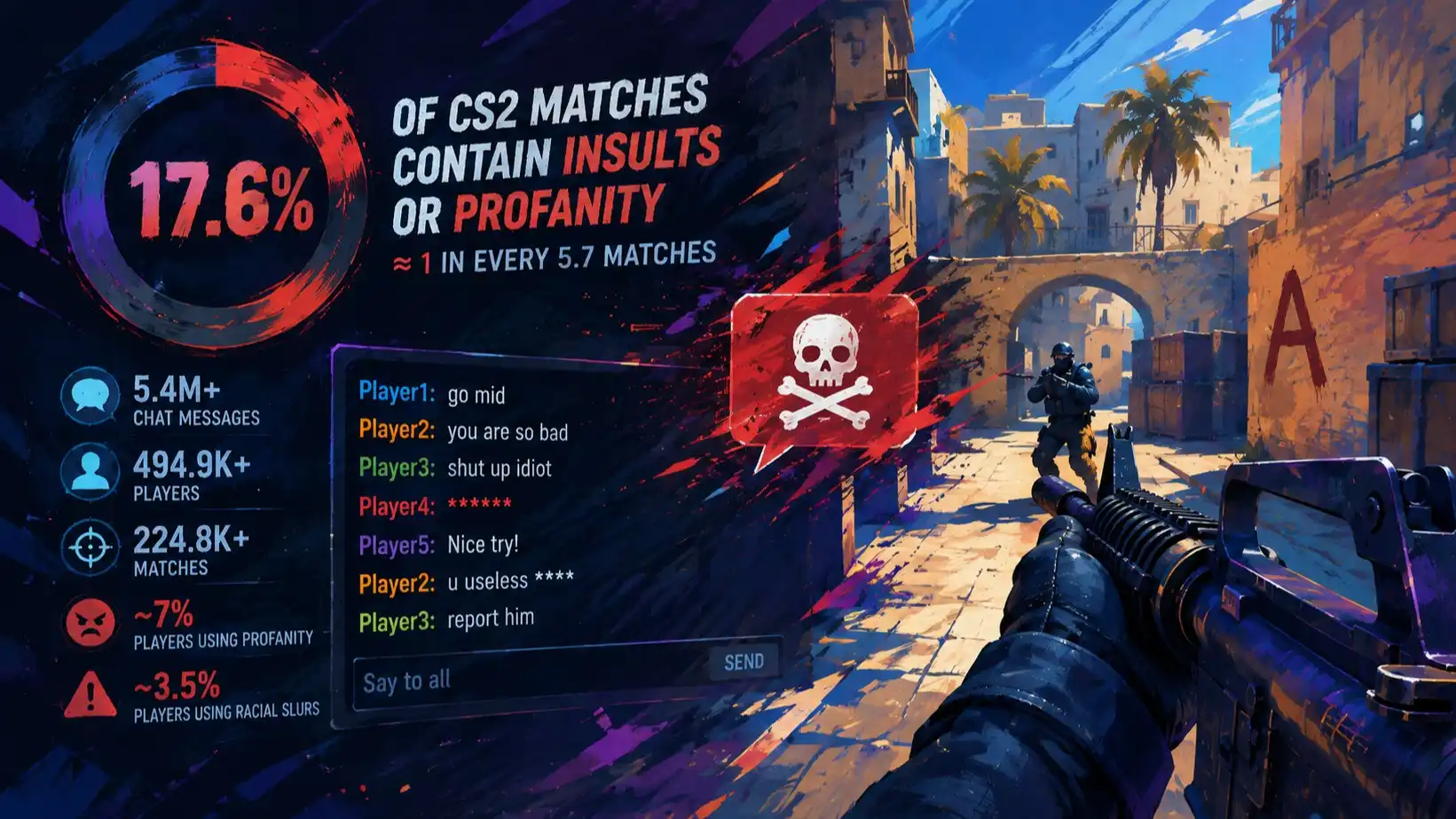
A large-scale analysis of Counter-Strike 2 match chats suggests that игроки в CS2 — CS2 players — encounter or use insulting and profane language in nearly one out of every six tracked matches.
According to statistics attributed to cstracker.gg, insults or profanity appeared in 17.6% of analyzed matches — roughly once every 5.7 games. The dataset reportedly covers more than 5.4 million chat messages, approximately 494,900 players and 224,800 matches.
The findings arrive as cstracker.gg is receiving wider attention for another reason: the service can associate text-chat messages extracted from tracked CS2 matches with public player profiles, raising questions about both toxicity and the persistence of in-game communication.
What the New CS2 Statistics Show
Counter-Strike 2 text chat is becoming part of a much larger discussion about toxicity, player behavior and the persistence of match data.
The headline number is 17.6%: the share of tracked matches in which players reportedly used insults or profanity. Expressed differently, the behavior appeared approximately once every 5.7 matches.
The scale of the underlying dataset makes the results noteworthy.
| Metric | Reported figure |
|---|---|
| Tracked chat messages | 5.4M+ |
| Players represented | 494.9K+ |
| Matches analyzed | 224.8K+ |
| Matches containing insults/profanity | 17.6% |
| Approximate frequency | 1 in 5.7 matches |
| Chatting players using profanity | ~7% |
| Players using racial slurs in the reported sample | ~3.5% |
The last figure requires particular care. Cybersport.ru reports that approximately 3.5% of players in the analyzed data used racial slurs, but the available reporting does not establish that this percentage applies to CS2's entire global player base.
Reported Daily Scale
The cstracker.gg estimates cited by Cybersport.ru also attempt to extrapolate the volume of problematic chat across CS2.
According to the report, players send more than 310 messages per second, while estimated daily totals include more than 560,000 profane or insulting messages, roughly 290,000 uses of the N-word, around 165,000 ableist insults, and more than 106,000 messages containing anti-LGBTQ+ insults.
These should be described as cstracker.gg estimates, rather than official Valve statistics.
Why the Dataset Needs Context
The numbers are substantial, but they do not necessarily mean that exactly 17.6% of all CS2 matches worldwide contain abusive communication.
cstracker.gg describes itself as a statistics service that processes Counter-Strike 2 match data into player profiles, match reports, leaderboards and other analytics. Its FAQ also makes an important methodological distinction: statistics on the platform relate to tracked players and tracked matches rather than automatically representing every CS2 player.
That distinction matters.
The analyzed matches could differ from the broader CS2 population by matchmaking mode, region, skill level, demo availability or other factors. Without a complete methodological breakdown for this specific toxicity dataset, CS2News.com would treat the results as a large observational sample, not a definitive census of Counter-Strike behavior.
Background: CS2 Chat Logs Have Become Publicly Searchable
The statistics are part of a wider story surrounding CS2 match data.
In late August 2026, players discovered that cstracker.gg profiles could display historical text messages associated with tracked Counter-Strike matches. Dexerto reported that some profiles contained hundreds or thousands of previous messages.
Other reporting indicates that individual messages can be connected to contextual match information such as the map, round and timestamp.
That transforms something many players may perceive as temporary match chatter into potentially persistent, searchable information.
Community discussion has subsequently focused not only on offensive messages but also on privacy and data retention. Some players have questioned whether historical match communication should be easily searchable through third-party profiles.
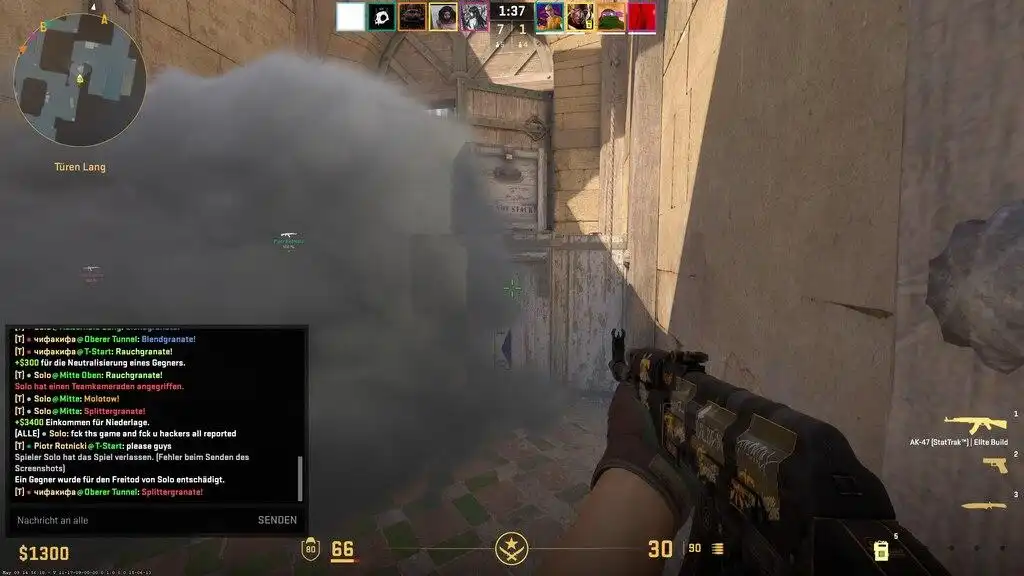
A demonstration of how CS2 players' historical in-game messages can now be searched through third-party match-tracking data.
Timeline
| Date | Development |
|---|---|
| Before Aug. 2026 | cstracker.gg processes CS2 match data and builds statistical player profiles |
| Aug. 27–28, 2026 | Wider community attention turns to publicly accessible historical CS2 chat logs |
| Aug. 28, 2026 | Multiple outlets report on searchable player chat histories |
| Sept. 1, 2026 | Discussion continues over whether CS2 demo/chat data should remain publicly accessible |
| Sept. 2, 2026 | Cybersport.ru reports cstracker.gg statistics showing insults/profanity in 17.6% of analyzed matches |
| Future | Any response or technical change from Valve: TBD |
The discovery of public chat histories was already generating debate several days before the new toxicity statistics were published.
Why This Matters for CS2 Players
The significance goes beyond proving something many Counter-Strike players already suspect: competitive matches can become toxic.
The dataset provides a potentially measurable baseline.
If cstracker.gg continues collecting comparable information, future datasets could potentially reveal whether toxic language changes over time, differs between matchmaking environments, or responds to moderation changes. Those comparisons would require consistent methodology and sufficient data before firm conclusions could be drawn.
There is also a second issue: persistence.
Trash talk that previously disappeared from a player's immediate view after a match can potentially become part of a searchable third-party profile when the relevant match data is available. That creates a different incentive structure for players who previously assumed their text-chat history was effectively ephemeral.
Impact Analysis
Player behavior
The most immediate effect may simply be greater awareness.
Players who know their match messages can potentially be retrieved later may become more cautious about what they type.
That does not guarantee less toxicity, but searchable histories change the consequences of sending abusive messages.
Moderation
Large datasets could potentially become useful for studying toxicity patterns, although automated classification introduces its own challenges.
Context matters heavily in online communication. Sarcasm, reclaimed language, quotations, multilingual slang and friendly exchanges between teammates can all complicate attempts to categorize messages automatically.
For that reason, raw keyword counts should not automatically be interpreted as confirmed incidents of targeted harassment.
Privacy
This may ultimately become the bigger story.
The controversy surrounding cstracker.gg demonstrates how match telemetry can be repurposed in ways players did not necessarily anticipate.
The service's FAQ explains that its profiles can include Steam identifiers, aliases, avatars, match statistics and other match-derived information.
Whether Valve changes how text-chat information is stored or exposed through match demos remains TBD.
Professional players and streamers
Public chat archives could have additional implications for recognizable players.
Messages connected to professional or streaming identities can circulate far beyond the original match. However, there is currently no evidence in the cited toxicity dataset that professional players are more or less likely to use abusive language than ordinary players.
Any such comparison would require separate data.
Historical Comparison: From Temporary Chat to Persistent Data
Counter-Strike has always had trash talk, arguments and hostile communication.
What is changing is not necessarily the existence of those behaviors, but their visibility and measurability.
A message once seen only by people inside a server can now potentially become:
match message → demo data → third-party processing → player profile → searchable historical record
That transition makes the cstracker.gg story relevant beyond a single set of profanity statistics.
It illustrates how increasingly detailed esports and matchmaking analytics can create entirely new categories of public player information.
What Changes Now?
For ordinary CS2 players, there is currently no confirmed Valve policy change connected to the reported statistics.
There is also no evidence from the cited sources that Valve has announced a new toxicity system specifically in response to cstracker.gg.
Therefore:
New Valve moderation measures: TBD
Changes to CS2 demo/chat storage: TBD
Valve statement regarding cstracker.gg: TBD
Changes to Premier matchmaking: none confirmed
Competitive/tournament rule changes: none confirmed
The immediate change is primarily informational: players now have greater awareness that text written during tracked matches may persist outside the game.
What to Watch Next
The biggest question is whether Valve responds.
Any modification to what CS2 demos store, how long relevant data remains available, or what third-party services can process could materially change the situation.
Another useful indicator will be whether cstracker.gg publishes deeper methodology. Breakdowns by region, matchmaking type, rank or time period would make the toxicity statistics substantially more informative.
Finally, future samples could show whether the publicity itself changes behavior. If players become aware that their messages are searchable, comparing toxicity rates before and after August 2026 could provide an interesting natural experiment.
FAQ
How often do CS2 players use insults?
According to cstracker.gg statistics reported by Cybersport.ru, insults or profanity appeared in approximately 17.6% of analyzed matches, equivalent to roughly one in every 5.7 games.
How many CS2 matches were analyzed?
The reported sample included approximately 224,800 matches, more than 494,900 players and over 5.4 million chat messages.
Does this mean 17.6% of every CS2 match worldwide contains toxicity?
Not necessarily. The figure comes from the matches tracked in the cstracker.gg dataset. Without evidence that the sample perfectly represents the entire global CS2 population, the statistic should not be generalized to every match.
Can CS2 chat messages be viewed online?
Some messages from tracked matches have been associated with public player profiles through cstracker.gg. Multiple outlets reported on the discovery in late August 2026.
Has Valve responded to these statistics?
No specific Valve response to this September 2 dataset was identified at publication time. Any future policy or technical changes remain TBD.
Related News