

BC.Game and Sashi VRS Loophole Explained: Valve’s New Major Region Rule

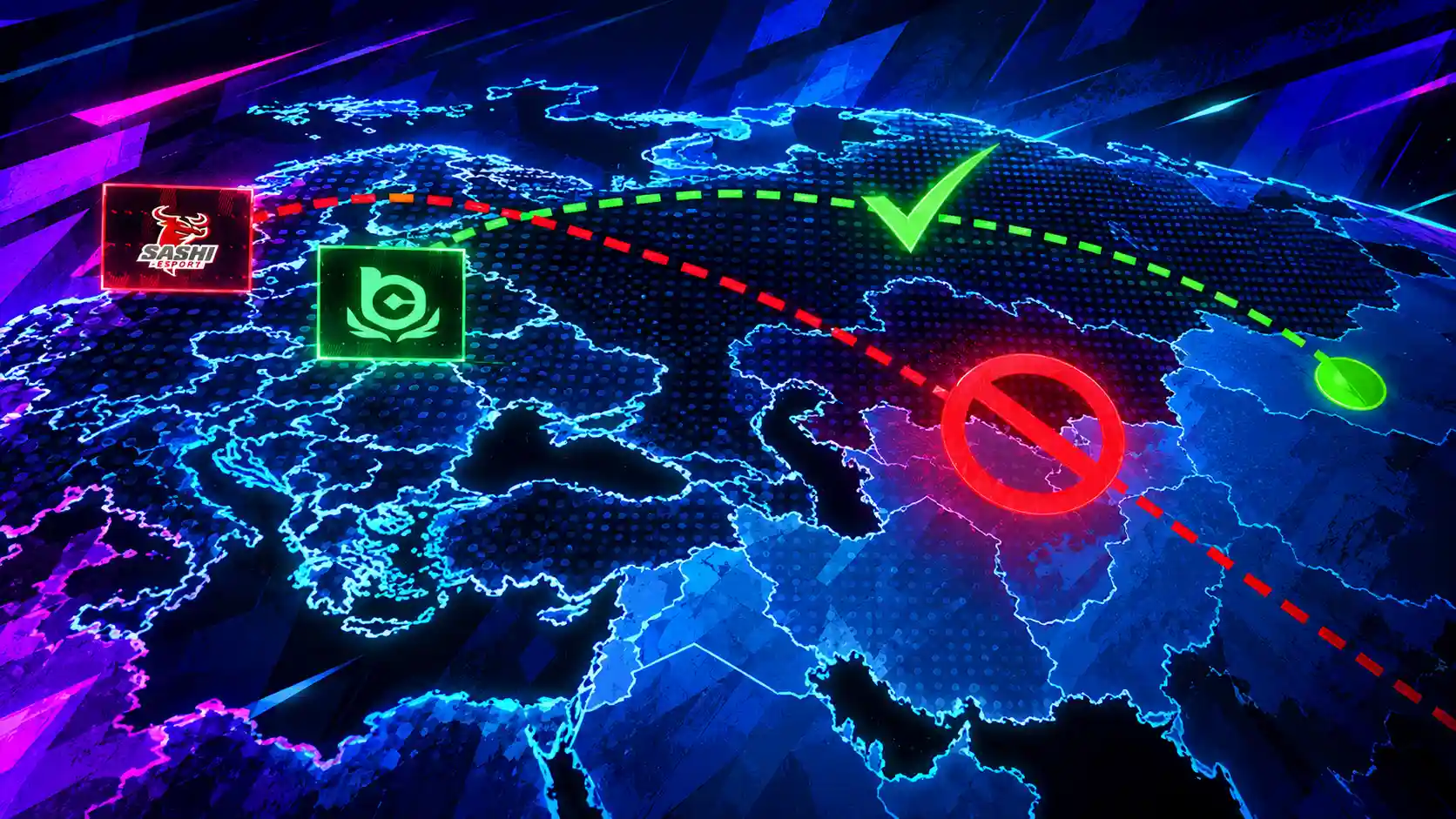
BC.Game and Sashi became the center of one of the most consequential Valve Regional Standings (VRS) controversies of the 2026 CS2 season after teams attempted late moves from Europe to Asia ahead of the PGL Major Singapore invitation deadline.
Valve responded by introducing a three-month restriction on regional assignments, effectively preventing last-minute VRS region switches for Major qualification. The developer then made a notable exception for BC.Game, while Sashi's attempt remained blocked.
The intervention appears to close the most straightforward version of the loophole, but HLTV Editor-in-Chief Milan "Striker" Švejda argued in his Strike #11 column that the underlying system may still leave room for manipulation — and that solving the problem at the ranking level could be cleaner than policing individual roster histories.
Quick Summary
| Question | Answer |
|---|---|
| Main teams involved | BC.Game, Sashi, WW |
| System involved | Valve Regional Standings (VRS) |
| Major | PGL Major Singapore 2026 |
| Original regions | Primarily Europe |
| Target region | Asia |
| Why switch? | Improve Major qualification prospects through the Asian VRS |
| Valve response | Introduced a three-calendar-month regional eligibility restriction |
| Effective for Singapore Major? | Yes |
| BC.Game outcome | Granted an official exception |
| Sashi outcome | No equivalent exception confirmed |
| WW outcome | No equivalent exception confirmed in the reviewed sources |
| Is region switching completely banned? | No |
| Is the loophole completely impossible to exploit? | Not necessarily |
| Confirmation status | Valve rule and BC.Game exception officially documented |
What Happened With BC.Game, Sashi and the VRS?
The controversy developed as the PGL Major Singapore 2026 invitation deadline approached.
Europe's Major qualification race had become highly competitive. Instead of continuing exclusively through that crowded regional standings battle, several teams explored moving into the Asian VRS.
WW, BC.Game and Sashi all attempted late switches from Europe to Asia.
The system created an obvious strategic incentive: if a roster could satisfy Valve's regional-assignment requirements while retaining enough of its accumulated VRS value, it could potentially move from a difficult qualification environment into one where the same ranking position had considerably more value.
The moves were permitted by the rules as they existed when teams began making them.
Valve then intervened.
On October 6, the developer added a new restriction to its Major rules: a roster cannot receive a regional assignment if it appeared on another region's VRS list during the preceding three calendar months.
That effectively introduced a waiting period for Major-related region switches.
The immediate problem was that organizations had already acted under the previous rules.
And that is where the BC.Game-Sashi controversy became much more complicated.
The New Valve Rule Explained
Valve's Major Supplemental Rulebook added the following requirement:
"A roster is only eligible for a Regional Assignment if they did not appear in any other region's VRS list in the preceding three calendar months."
In simple terms, a team cannot appear in Europe's relevant VRS list and then rapidly transform itself into an Asian Major-qualification roster.
For Major invitations, the switch effectively requires a three-calendar-month separation.
Valve also clarified to HLTV that the restriction applies based on the Major invitation date, rather than three months before the Major itself.
Importantly, the change was specifically relevant to Major regional assignments. HLTV reported that teams remained eligible for non-Major tournament invitations despite the restriction.
Why Sashi Became the Flashpoint
Sashi's move was particularly aggressive.
The Danish organization added Australians Tynan "TjP" Purtell and Jordan "Hatz" Bajic at the beginning of October.
Alongside Anton "Anlelele" Huynh, who holds Vietnamese citizenship, those additions gave Sashi the player composition necessary to pursue an Asian regional assignment. 
The organization's intent was not hidden.
According to subsequent reporting, the changes were designed to increase Sashi's chances of reaching the Singapore Major.
The timing was critical.
Sashi made its move approximately one month before the Major invitation deadline rather than establishing itself as an Asian team over an extended competitive period.
HLTV's Striker characterized Sashi as an extreme example of the regional-switch problem because the organization combined new signings with a nationality-related element to rapidly establish an Asian core.
Valve's October 6 intervention effectively stopped the strategy from producing the intended Major qualification route.
Why BC.Game Was Different
BC.Game's case looked similar on the surface but contained several important differences.
The organization already had two prominent Mongolian players: Azbayar "Senzu" Munkhbold and Ayush "mzinho" Batbold.
It then used Australian player Tyson "asap" Paterson as the third Asia-region player necessary for the regional switch.
Unlike the Sashi case described by HLTV, BC.Game did not rely on changing a player's represented nationality.
More importantly, BC.Game had already played enough matches with asap for its new roster to appear in the Asian VRS before Valve introduced the new restriction.
That distinction became central to the eventual ruling.
BC.Game's Asian Lineup
At the time of Valve's exception, BC.Game's lineup was listed as:
| Player | Regional relevance |
|---|---|
| Oleksandr "s1mple" Kostyliev | European core |
| Emil "Magisk" Reif | European core |
| Azbayar "Senzu" Munkhbold | Mongolia / Asia |
| Ayush "mzinho" Batbold | Mongolia / Asia |
| Tyson "asap" Paterson | Australia / Asia regional assignment |
| Wiktor "TaZ" Wojtas | Coach |
Valve's eventual exception explicitly identified the asap, Magisk, mzinho, s1mple and Senzu roster as assigned to Asia and eligible for a Major invitation.
That was a crucial distinction: BC.Game did not merely announce plans to become Asian. Its new configuration had already produced an Asian VRS entry.
Why Valve Gave BC.Game an Exception
The original October 6 rule update created an unexpected problem for BC.Game.
Under the new three-month restriction, its roster had previously appeared in Europe's VRS and therefore would not normally have been eligible for an immediate Asian Major assignment.
Valve initially told HLTV that affected teams were effectively out of the Major race unless they contacted the developer and found a solution.
BC.Game appealed.
CEO Ali "Ako" Muhanned even publicly offered to have the organization's Asian VRS points reset and start again from zero.
Valve ultimately chose another solution.
On October 7, its tournament-operation exceptions documentation was updated to explicitly allow BC.Game's lineup to represent Asia and remain eligible for a Singapore Major invitation.
HLTV's Striker highlighted three distinctions between BC.Game and the other cases:
- BC.Game had not used a nationality switch.
- It had already completed the switch on paper and appeared in the Asian VRS before the new rule.
- Senzu and mzinho were established Asian players who had previously represented one of the region's strongest teams.
The first two are concrete procedural differences. The third is contextual rather than a published eligibility criterion, and should not be presented as an official Valve justification.
Valve's public exception confirms that BC.Game received special eligibility, but it does not establish every factor that determined the developer's final decision.
BC.Game vs. Sashi: Why Their Outcomes Differed
| Factor | BC.Game | Sashi |
|---|---|---|
| Attempted move | Europe → Asia | Europe → Asia |
| Asian/Oceanic additions | asap, alongside existing Senzu and mzinho | Hatz and TjP alongside Anlelele |
| Used nationality-related element | No nationality switch identified by HLTV | Anlelele's Vietnamese citizenship was relevant |
| Completed Asian VRS registration before new rule | Yes | Not equivalent in reviewed reporting |
| Affected by October 6 rule | Initially yes | Yes |
| Valve exception | Yes | No equivalent exception confirmed |
| Singapore Major path via Asia | Allowed | Blocked under new rule |
The unequal outcome immediately became part of the controversy.
Sashi later abandoned its short-lived Oceanic project. On October 23, HLTV reported that Hatz and TjP had left the organization, with Sashi owner Claus "D0KT0R3N" Nielsen arguing that BC.Game had received "preferential treatment."
That allegation represents Sashi's position, not an established finding about Valve's motives.
Timeline: How the VRS Region-Swap Controversy Developed
| Date | Development | Impact |
|---|---|---|
| Previous Major cycle | Liquid uses a roster change involving malbsMd to move from Europe toward an Americas regional path | Demonstrates how regional assignment could be strategically changed |
| September 2026 | BC.Game moves toward an Asian core | Regional-switch issue becomes relevant to Singapore qualification |
| September 2026 | WW also pursues an Asia switch | Shows strategy is spreading |
| Early October 2026 | Sashi signs Hatz and TjP | Creates another late Europe-to-Asia switch |
| October 6 | Valve changes Major regional-assignment rules | Introduces three-calendar-month restriction |
| October 6 | Valve says affected teams need to "find a solution" | BC.Game, Sashi and WW face Major eligibility problems |
| October 7 | Valve grants BC.Game an exception | BC.Game can remain in Asia for Major qualification |
| October 13 | HLTV publishes Strike #11 | Examines whether Valve actually solved the structural loophole |
| October 19 | HLTV revisits the VRS controversy | Debate continues over whether manipulation remains possible |
| October 23 | Sashi parts with Hatz and TjP | Short-lived Asian project effectively ends |
Valve's intervention was therefore not simply a theoretical rules update. It changed the competitive consequences of roster decisions organizations had already made.
The Historical Precedent: Liquid and DRILLAS
The BC.Game-Sashi dispute did not emerge from nowhere.
Two previous cases help explain why Valve eventually acted.
DRILLAS
Valve had previously addressed a different regional loophole involving DRILLAS, where a team could qualify through one region before changing its regional makeup through a substitution around the Major.
That route was subsequently closed.
Liquid
Liquid then demonstrated another path.
In the previous Major cycle, Liquid brought in Guatemalan rifler Mario "malbsMd" Samayoa for Guy "NertZ" Iluz, allowing the roster to move from Europe toward an Americas assignment.
HLTV's analysis argues that this exposed the regional-assignment weakness before the BC.Game and Sashi cases exploded in October.
That history matters because it strengthens one of the principal criticisms of Valve's intervention: the underlying strategy was not entirely new when teams made their Singapore Major moves.
Why the BC.Game and Sashi Case Matters
This controversy goes beyond whether one particular team deserves to attend a Major.
The VRS now determines access to an enormous part of Counter-Strike's professional ecosystem.
That creates powerful incentives to optimize not only match results but also where those results count.
A European roster near the edge of relevance in a crowded regional ranking may have much stronger Major prospects if the same ranking value can suddenly be carried into a less competitive regional list.
Without restrictions, organizations could theoretically treat player nationality and roster construction as tools for regional ranking arbitrage.
That creates two competing principles.
Teams should be allowed to genuinely relocate or build multinational rosters.
But teams that have accumulated their ranking position in Europe should not necessarily be able to carry that entire advantage into Asia immediately before a Major deadline and jump ahead of organizations that competed in Asia throughout the season.
Valve's new rule is an attempt to separate those scenarios.
Did Valve Actually Close the Loophole?
Not completely, according to the analysis published in Strike #11.
Valve clarified to HLTV that its check concerns lineups contained in a team's match history and whether those lineups appeared in multiple regional VRS invitation lists during the preceding three months.
The relevant lineup is the final configuration shown in the monthly ranking overview.
That creates a potential edge case.
HLTV's analysis suggests an organization could theoretically manipulate which lineup appears as its final monthly VRS configuration by timing another roster update before the monthly release. That could make the team's actual competitive history and its formal monthly roster representation diverge.
This is a theoretical vulnerability identified by HLTV, not evidence that a team has successfully used that method.
The rule therefore makes last-minute regional shopping substantially harder, but describing the system as mathematically impossible to exploit would go beyond the available evidence.
Key Details
| Issue | Current status |
|---|---|
| Can teams change VRS regions? | Yes |
| Can they instantly use a new region for a Major invitation? | Generally no |
| Major regional waiting period | Three preceding calendar months without appearing in another region's VRS |
| Does rule affect Major invitations? | Yes |
| Does the same restriction automatically block normal event invitations? | No, according to HLTV's reporting on Valve's clarification |
| BC.Game exception | Officially granted |
| Sashi exception | Not confirmed |
| WW exception | Not confirmed |
| Is BC.Game assigned to Asia for Singapore qualification? | Yes |
| Is all regional manipulation impossible now? | No definitive evidence supports that conclusion |
| Financial terms of Sashi's temporary signings | TBD |
Ranking/VRS Impact
The VRS impact is the central competitive consequence of the story.
Under the previous framework, a team could potentially retain substantial ranking value while changing the regional list in which that value was applied.
Valve's three-month restriction breaks the usefulness of a last-minute switch for Major qualification because the new regional assignment cannot immediately be used to secure an invitation.
BC.Game is the major exception.
Valve explicitly ruled that its five-player lineup could remain assigned to Asia and be eligible for the Singapore Major despite the newly introduced restriction.
Sashi did not receive the same publicly documented exemption.
No additional VRS point totals are inserted here because current totals fluctuate and are not necessary to explain the rule itself.
Tournament Impact: PGL Major Singapore 2026
The immediate tournament affected is the PGL Major Singapore 2026.
Asia has limited Major invitation positions, so inserting European-origin teams with accumulated VRS value could directly displace teams that spent the season competing within the region.
HLTV's Striker argued that if all three late-switching teams had succeeded, three of Asia's five Major positions could have gone to teams that had not meaningfully spent the season competing in Asia.
Valve's intervention prevented that scenario.
BC.Game, however, retained its Asian path because of the specific exception.
That means the rule did not completely reverse every pre-change regional switch; Valve instead handled at least one affected roster individually.
A Cleaner Alternative? Fix the Ranking, Not the Roster
Strike #11 proposes a different solution.
Rather than blocking regional assignments through historical invitation lists, Valve could potentially alter how regional VRS points are recognized.
Under that concept, a team's global ranking could remain intact, while regional rankings would count only results earned with a lineup containing at least three players from that region.
A team genuinely moving from Europe to Asia could therefore still exist and retain its global competitive identity.
But it would need to establish regional ranking value rather than importing all of its European advantage into Asia.
That is an editorial proposal from HLTV, not a Valve-announced change.
Its advantage is conceptual simplicity: instead of deciding whether a region switch is genuine, the ranking itself would reduce the incentive to make a purely qualification-driven switch.
Competitive Impact
There is no conventional tactical impact here because Valve has not changed weapon balance, maps or in-game mechanics.
The competitive impact is structural.
Organizations now have to think much further ahead when building a roster that changes regional identity.
A team considering Europe-to-Asia movement cannot reasonably wait until the final weeks of a Major qualification race and expect the new assignment to take effect immediately.
That potentially increases the cost of short-term regional optimization while making genuine long-term region changes easier to distinguish.
It could also influence contract strategy. Organizations pursuing another region may need to commit to the roster months before the relevant Major deadline rather than signing temporary players for a short qualification window.
What Changes Now?
For BC.Game, Valve's explicit exception means the roster is assigned to Asia and eligible for the Singapore Major invitation process.
For Sashi, the immediate Asian Major plan failed to produce the intended outcome.
The organization later parted ways with Hatz and TjP, effectively ending that version of the project less than a month after it began.
For future teams, the message is clearer: changing regional identity shortly before a Major invitation deadline is no longer a reliable qualification strategy.
What remains less clear is whether Valve will eventually apply a similar framework throughout the broader year-long tournament ecosystem or modify the VRS itself.
What to Watch Next
The biggest question is whether Valve treats the three-month restriction as a permanent solution or only as another patch to an evolving VRS system.
Future monthly ranking releases will also show whether teams discover new legal methods of changing regional assignment without triggering the restriction identified in October.
Another point to watch is how tournament organizers interpret roster histories if similar regional eligibility rules are extended beyond Major invitations. More complicated historical checks increase the possibility of administrative mistakes.
Finally, BC.Game's exception may become an important precedent. Future organizations facing unusual regional circumstances could point to this case when asking Valve for individual consideration, although there is no evidence that the BC.Game ruling guarantees comparable exceptions.
Related Teams, Players and Events
BC.Game — central team in the controversy and the only one among the three discussed here to receive a documented Valve exception for the Singapore Major Asian qualification route.
Sashi — Danish organization whose late move toward an Asian core helped accelerate scrutiny of the regional-assignment rules.
WW — another Europe-based team involved in the wave of attempted Asia switches before Valve's intervention.
s1mple — BC.Game star and member of the five-player lineup explicitly named in Valve's regional exception.
Senzu and mzinho — Mongolian players whose presence formed two parts of BC.Game's Asian core.
asap — Australian player whose addition gave BC.Game the third Asia-region player needed for its switch.
Hatz and TjP — Australian players signed by Sashi during its attempted Asia pivot; both subsequently left the organization.
PGL Major Singapore 2026 — the Major whose invitation race triggered the immediate controversy.
FAQ
Why did BC.Game and Sashi try to move to the Asian VRS?
The moves offered a potentially easier route to PGL Major Singapore qualification than remaining in the highly competitive European VRS. WW also attempted an Asia switch during the same period.
What rule did Valve introduce?
Valve introduced a rule making a roster ineligible for a Major regional assignment if it appeared in another region's VRS list during the preceding three calendar months.
Why can BC.Game qualify through Asia?
Valve granted BC.Game a specific exception. Its lineup of asap, Magisk, mzinho, s1mple and Senzu was officially assigned to Asia and declared eligible for a Major invitation.
Did Sashi receive the same exception?
No equivalent exception for Sashi has been identified in the reviewed sources. The organization later parted ways with Hatz and TjP after its Singapore Major regional strategy was blocked.
Is the VRS region-switch loophole completely closed?
The easiest last-minute version has been substantially restricted, but HLTV's analysis identified theoretical ways the system could still be manipulated through how monthly VRS lineups are recorded. No evidence reviewed here establishes that such a method has actually been successfully exploited.
Related News